How can we better understand the issues of our time without getting lost in simplistic thinking or catastrophism? The reflective exploration framework offers a path for situating and enriching one’s way of thinking, from spontaneous intuition to critical lucidity.
Through its narrative version and its infographics, it invites everyone to explore their own biases, to cultivate fruitful doubt and to progress towards a more open and fairer way of thinking.
A path to thinking better about the world’s challenges
No one wakes up one morning with a clear, balanced view of the ecological, social and economic problems of our time. Each of us moves forward, at our own pace, along a path of understanding made up of moments of awareness, learning, doubt, sometimes revolt and, ideally, a gradual broadening of perspective.
This path may begin with ignorance. We do not know, or we refuse to know. There is no visible problem. Then an event, an encounter, a documentary or a book shatters this carefree state. Something is wrong with the way we inhabit the world.
Then comes the time for the first simple answers. Global warming? We have understood that it comes from our emissions, and that is correct. The solution seems self-evident: consume less, sort our waste, multiply small gestures. We embrace strong ideas, look for those to blame, and denounce.
But with time, things become more complicated. We discover that our individual efforts have limits. That there are perverse effects, contradictions, grey areas. We come to understand that denouncing is not enough, that it can even antagonise others and provoke rejection. Anger gives way to doubt, and then to nuance.
We then begin to question our own certainties. To explore opposing theses not in order to discredit them out of hand, but to better understand where they come from. We discover that some well-intentioned policies can do more harm than good, that slowing the economy without a social safety net can worsen human suffering, or that some countries manage to reduce their emissions while maintaining their standard of living.
Gradually, our outlook broadens. We understand that nature is not a fixed ideal to be preserved intact, but a living fabric in constant transformation, which humans can damage… or heal. That the question is not about ‘going back’, but about building desirable futures that are both responsible and supportive.
So we no longer seek merely to be right. We seek to think better, in order to act better. We become more alert to simplistic reasoning, to catastrophist narratives with no way out, to illusions of innocence. We learn to combine hope and lucidity, radicalism and prudence.
We have been down this path ourselves. In 2013, we thought that improving the world came down to reducing the human footprint, so as to transform it less. Thirteen years of reading, figures and debates have made us change our minds on several points: from technological sufficiency to decoupling, from the defence of ‘nature’ to attention to beings who can feel (our story). This framework grew out of that journey: it serves first and foremost ourselves.
This path is not linear. It may involve steps backwards, forks in the road, accelerations. There is no final position, only stances that are more or less open, more or less informed. This framework is therefore not a test, but an invitation: to situate one’s own thinking, to enrich it, to challenge it, to let it mature.
It is a tool for discernment, to contribute with judgement to the transformation of the world.
The six levels
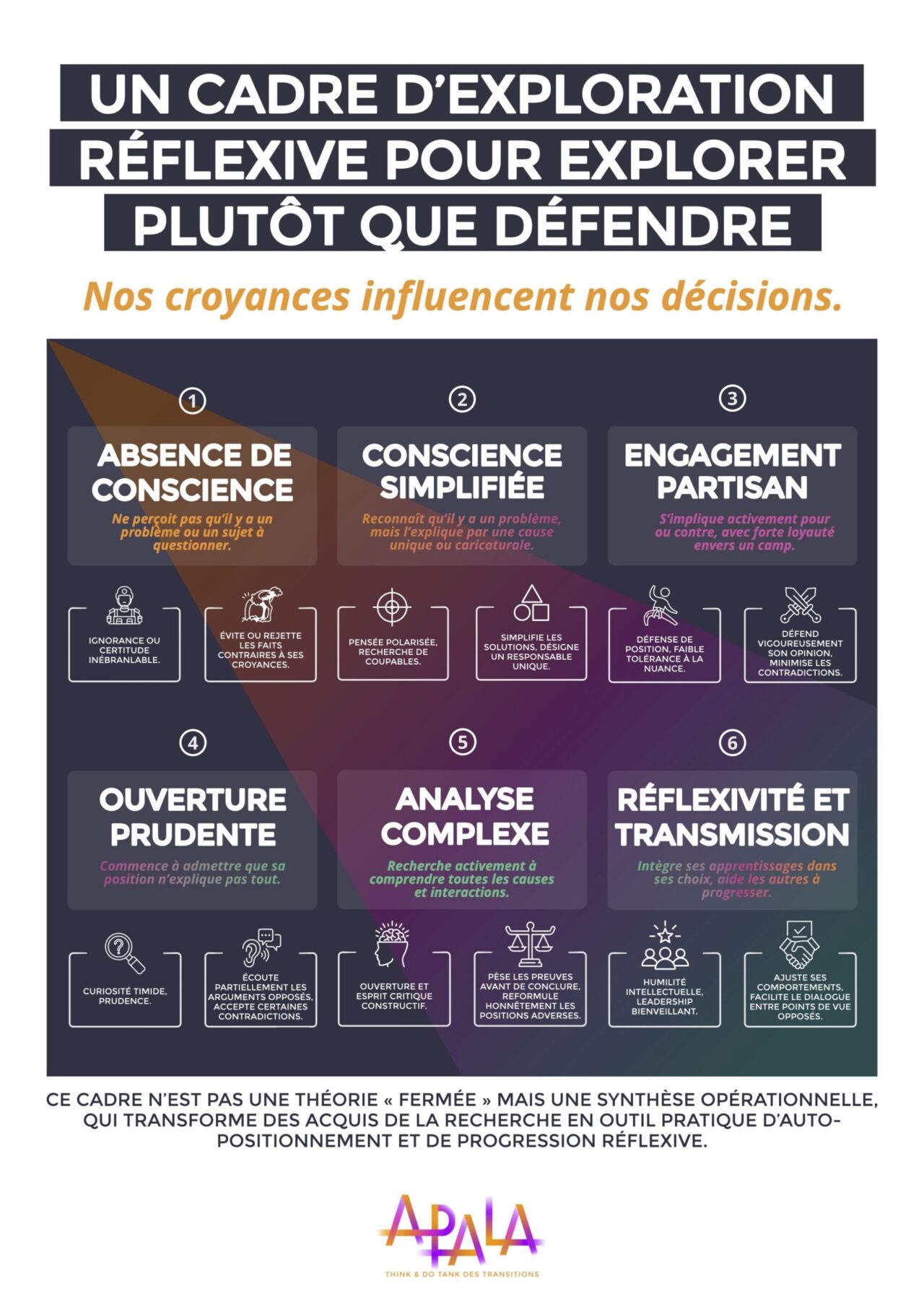
The framework distinguishes six levels. They do not describe what one thinks, but the way in which one holds one’s ideas: how one receives unwelcome information, how one treats those who disagree, what might make us change our minds. One can defend the same opinion at level 2 or at level 5; what changes is the way of arriving at it and of keeping it.
- Lack of awareness. We do not perceive that there is a problem or a question, often because we have never been confronted with it or because the answer seems self-evident. No one can take an interest in everything: this is our starting point on most subjects.
- Simplified awareness. We recognise that there is a problem, but we explain it by a single cause and look for someone to blame.
- Partisan commitment. We get actively involved, for or against, and loyalty to our side comes before examining the facts. Commitment is not the problem (one can be committed at every level); the problem is defending an idea because it is that of one’s group.
- Cautious openness. We begin to admit that our position does not explain everything; we listen, in part, to opposing arguments.
- Complex analysis. We seek to understand all the causes and their interactions; we weigh the evidence before concluding, and we distinguish what is a matter of facts from what is a matter of values.
- Reflexivity and transmission. We build what we have learnt into our choices, remain ready to revise our convictions and help others to progress, by facilitating dialogue between opposing points of view. A good test: being able to restate the other person’s position so clearly that they say ‘I couldn’t have put it better myself’, before criticising it (‘Rapoport’s rules’, popularised by the philosopher Daniel Dennett) [1].


The reflective exploration framework
Exploring one’s own way of thinking is a journey that unfolds in stages. The reflective exploration framework proposes to represent this journey as a progression, from the most spontaneous and defensive forms of thinking to the levels at which the mind becomes truly curious, critical and open.
At the outset, each of us tends to defend our beliefs and ideas. Our first intuitions serve as a compass, but they also come with biases: we look for arguments that confirm what we already think (confirmation bias), we instinctively reject whatever contradicts us, and we confuse loyalty to a group with the truth of an idea. These mechanisms are not faults; they are human: they correspond to the first levels of the framework.
The path consists in rising from these spontaneous reactions towards a more conscious and demanding practice of reflection. This involves several lessons:
- Recognising our biases and accepting that our intuitions are not always reliable.
- Learning to question our certainties, even those that reassure or define us.
- Developing an exploratory stance: asking ourselves ‘What if I were wrong?’ or ‘What can I learn from this opposing point of view?’.
- Placing more value on the search for truth than on the defence of our opinions.
As we progress through these levels, reflection becomes less an exercise in justification and more a process of inquiry. We move from a tense relationship with disagreement to a genuine curiosity about what it reveals. We begin to welcome contradictions as opportunities to understand better, rather than as threats.
The final stage of this path is not a definitive enlightenment, but a lasting attitude of openness and critical learning. It means knowing how to live with uncertainty, being willing to revise one’s convictions when the facts demand it, and cultivating constant vigilance towards the blind spots of one’s own thinking.
Where this framework comes from
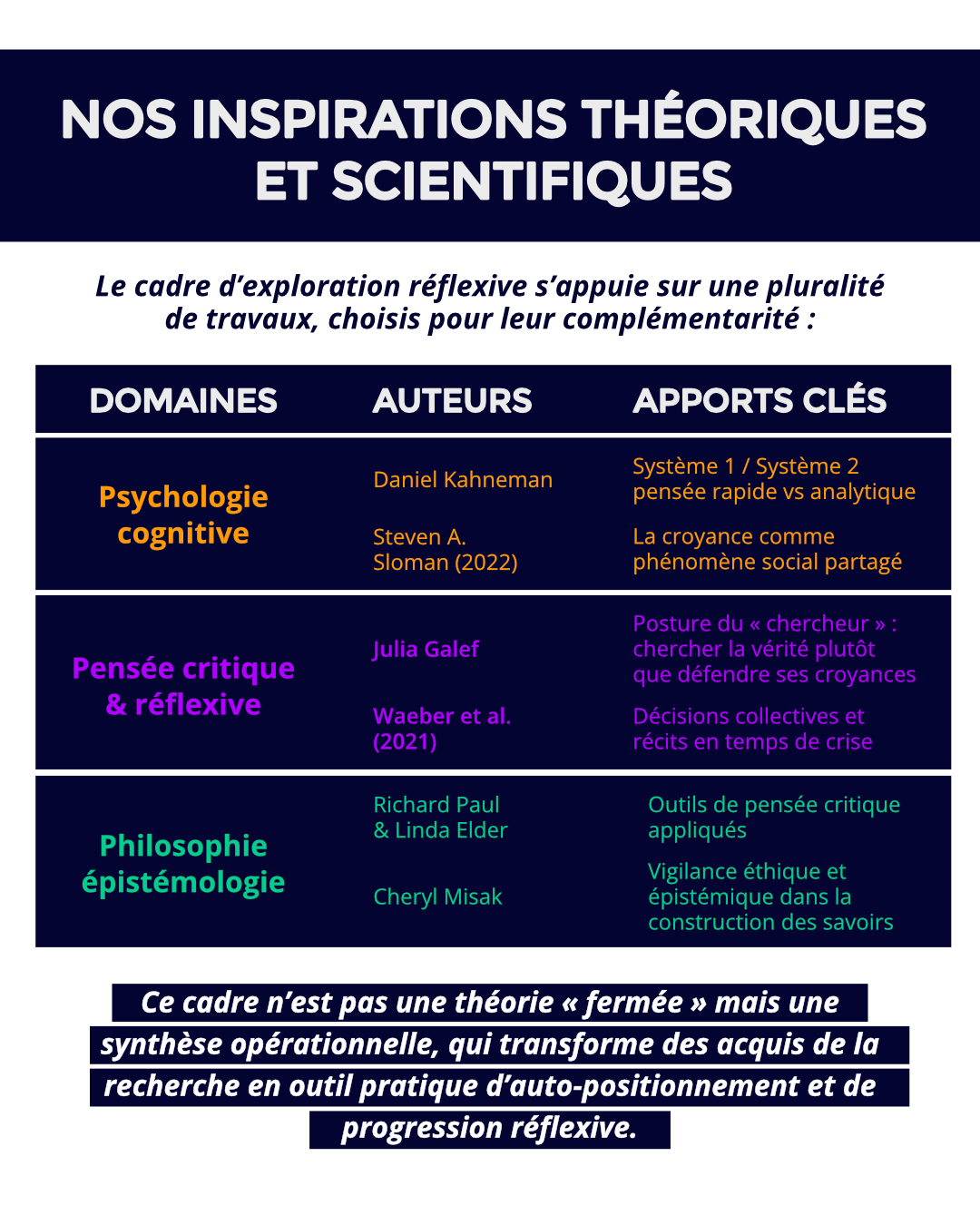
This framework draws on varied work in cognitive science, psychology and philosophy, which converges on a single idea: thinking well is not a state but a journey. Here they are, with what we owe them.
The idea that there are more or less reliable ways of fixing one’s beliefs is an old one. In 1877, the philosopher Charles S. Peirce already distinguished four of them in ‘The Fixation of Belief’ [2]: clinging to what one believes, following an authority, adopting what seems reasonable a priori, or submitting one’s ideas to the test of facts.
Our most direct model is the theory of the development of critical thinking [3] by Linda Elder and Richard Paul (Foundation for Critical Thinking), which describes six stages, from the ‘unreflective’ thinker to the ‘accomplished’ thinker. We borrow from it the idea of a six-level progression and apply it to debates on transitions.
In developmental psychology, Deanna Kuhn and her colleagues have shown that people often move from an ‘absolutist’ view of knowledge (there is one truth, and I have it) to a ‘multiplist’ view (everything is equally valid, everyone has their own opinion), before arriving, sometimes, at an ‘evaluativist’ view, in which opinions are compared against criteria (Kuhn, Cheney and Weinstock, 2000 [4]). This is the whole difference between the openness we advocate and relativism: being open does not mean thinking that everything is equally valid. Patricia King and Karen Kitchener described a similar path, that of ‘reflective judgement’, in seven stages (Developing Reflective Judgment, 1994 [5]).
On our biases, Daniel Kahneman popularised the distinction between fast, intuitive thinking (‘system 1’) and slow, analytical thinking (‘system 2’) in Système 1 / Système 2. Les deux vitesses de la pensée (Flammarion, 2012 [6]). He himself presented these two ‘systems’ as convenient characters rather than as parts of the brain, and some of the findings in his book, on priming in particular, have not stood up to attempts at replication. Steven Sloman points out that our beliefs are largely social: unable to check everything, we believe what our community believes (‘How Do We Believe?’, 2022 [7]). Hugo Mercier and Dan Sperber draw an encouraging conclusion from this: we reason poorly on our own, but much better in groups, when we argue (L’Énigme de la raison, Odile Jacob, 2021 [8]).
Julia Galef contrasts the ‘soldier’ mindset, which defends its positions, with the ‘scout’ mindset, which seeks the truth rather than defending its beliefs (The Scout Mindset, 2021 [9]). This is the mindset we aim for.
Paul Waeber and his colleagues, including Philip Fernbach and Steven Sloman, propose a simple framework for untangling a disagreement: is it about information, beliefs, values or means? (‘Choices We Make in Times of Crisis’, 2021 [10]). A disagreement over values cannot be settled with figures, nor a disagreement over facts with values.
Finally, the philosopher Cheryl Misak argues that our beliefs, including moral ones, aim at truth and must remain open to experience and argument (Truth, Politics, Morality, 2000 [11]): this is the idea of inquiry that runs through this text.
What this framework is not
It is not a scientific result. It is a reading framework inspired by this research, which has not been tested as such: we do not know whether everyone passes through these levels, or in this order.
It is not a ranking of people. Each of us is at level 2 on subjects we know little about and at level 5 on others. The framework questions ways of thinking, not people.
It is not a ranking of opinions. One can go the whole way and still not share our conclusions: a disagreement over values is not a delay. Nor is the summit always the middle ground: sometimes, examining the evidence fully vindicates one of the positions. That current warming is caused by human activities, for example, is established ‘unequivocally’ (IPCC, 2021 [12]).
It is not a protection against biases. Knowing more does not make us less partial. On climate, the people most at ease with numbers are also the most polarised (Kahan et al., 2012 [13]); the best informed are the most skilled at dismantling the arguments of the opposing side (Taber and Lodge, 2006 [14]); this bias affects people across the political spectrum about equally (Ditto et al., 2019 [15]); and everyone believes they are less biased than others (Pronin, Lin and Ross, 2002 [16]). Hence a safeguard: if you place yourself at level 6, ask someone who disagrees with you where they would place you.
Examples, level by level
In each example, the six paragraphs follow the six levels. The first levels are found in all camps: we have shown this whenever it was useful. Our own position, where we have one, is given separately at the end: it is open to debate, and it is not ‘level 6’.
1. Lack of awareness. Nature is taken for granted: a backdrop, beautiful and good, that no one thinks to question. We love it ‘because it is good’, without asking what we love in it, or why it should be protected.
2. Simplified awareness. Then the narrative becomes simpler: nature is a pure and harmonious space, and if it is faring badly, it is solely because of human activities. It would be enough to ‘go back’ or to ‘leave nature alone’ to restore its balance.
3. Partisan commitment. Defending nature becomes an absolute cause, against an identified enemy: industrialisation, modernity, capitalism. The debate is organised between ‘protectors’ and ‘destroyers’. On the other side, others hold the opposite position with the same assurance: nature is merely a resource, and those who defend it are enemies of progress. Each camp caricatures the other.
4. Cautious openness. Gradually, doubt sets in: nature is not always gentle or welcoming. It is also brutal, random, sometimes hostile: parasites, diseases, disasters. And some conservation programmes harm the very individuals they claim to protect. The idea of a benevolent nature begins to crack.
5. Complex analysis. Thinking becomes more complex: nature is not a harmonious whole but a set of dynamics. Ecosystems evolve, sometimes with or thanks to human action, and the boundary between ‘natural’ and ‘artificial’ becomes blurrier. We also discover several ways of grounding the value of nature (for its own sake, for our sake, for the beings that live and feel in it), which do not lead to the same decisions.
6. Reflexivity and transmission. At the most advanced stage, we distinguish what concerns facts (what is happening?) from what concerns values (what do we want to protect, and why?). We recognise that nature is neither good nor bad in itself: protecting it is a human and ethical choice, which depends on our values and priorities. We can then discuss with those who do not share these values without treating them as enemies.
Our position: transforming nature can be destructive, but also beneficial, if it improves the living conditions of sentient beings, human and animal. We therefore judge an intervention by its effects on those who feel, rather than by its ‘natural’ character (our history).
1. Lack of awareness. Biodiversity is an abstract word. We are not quite sure what it covers, or whether there is any reason to worry about it.
2. Simplified awareness. Then we take up, without distance, the most widespread narrative: a ‘sixth extinction’ is under way, catastrophe is imminent, everything is collapsing. Others adopt an equally simple explanation in the opposite direction: species have always disappeared, there is nothing to worry about.
3. Partisan commitment. Each camp chooses its figures: the ‘−73%’ of the Living Planet Index for some, the return of wolves or whales for others. To doubt the collapse is to be ‘in denial’; to worry about it is to be ‘catastrophist’.
4. Cautious openness. Then come the doubts. Christian Lévêque, an ecologist, and Thomas Lepeltier, historian and philosopher of science and director of our Think Tank (Sommes-nous entrés dans une sixième extinction ?), point out that the notion of biodiversity is vague and that documented extinctions remain limited: around 900 since 1500, or 1.5% of bird and mammal species, far from the 75% that define a mass extinction (Barnosky et al., 2011 [17]). Other researchers, such as Robert Cowie and his colleagues, respond that if we count invertebrates, which are poorly monitored, the sixth extinction has probably begun (Cowie, Bouchet and Fontaine, 2022 [18]). We discover that both camps rely on data, and that we need to look at which data.
5. Complex analysis. We look more closely. The ‘−73%’ is an average, pulled down by populations in very steep decline: among the monitored vertebrate populations, around 40% are increasing and nearly half are decreasing (chart below). Hervé Le Guyader, an evolutionary biologist, calls for swift action to protect habitats, without giving in to catastrophism (Biodiversité : le pari de l’espoir, 2020 [19]). Philosophers such as Jonathan Newman and his colleagues (Defending Biodiversity, 2017 [20]) or Emma Marris (Wild Souls, 2021 [21]) question the intrinsic value of species: a species is a category, it does not suffer; individuals do. Newman and his colleagues nonetheless remain in favour of conservation. Biodiversity is neither sacred nor useless: it also includes parasites and diseases, but its massive loss can undermine balances on which we depend.
6. Reflexivity and transmission. The most advanced stance consists in holding these data together, refusing both alarmist oversimplifications and reassuring denials, and stating clearly what concerns facts (how many species, which trends) and what concerns values (what do we want to protect first?).
Our position: biodiversity is declining, but the data do not show a general collapse, and pressure on natural habitats could ease as the population stabilises and agricultural yields improve. We therefore prefer to speak of priorities rather than crisis (Il n’y a pas de crise de la biodiversité !).
1. Unawareness. You have never heard of planetary boundaries, or they are just one more technical term.
2. Simplified awareness. Then you discover them as an indisputable truth: an absolute threshold that humanity must not cross, on pain of imminent catastrophe. If we cross the boundaries, everything collapses; if we stay within them, we are ‘safe’.
3. Partisan commitment. The boundaries become a banner: the definitive proof that growth is impossible, or that industrial modernity is destructive by nature. Any criticism of the framework is treated as denial. On the other side, others reject them wholesale as a campaigners’ invention, without having read them.
4. Cautious openness. Reading the authors themselves, you discover that the concept does not say ‘imminent catastrophe’: Johan Rockström and his colleagues, as a precaution, place the boundaries at the lower end of a zone of uncertainty, in order to define a ‘safe operating space’ (Rockström et al., 2009 [22]). The authors acknowledge that the thresholds are conventional; the simplification lies mainly in public use.
5. Complex analysis. You discover the serious criticisms: for biodiversity or land use, there is no clear planetary threshold, and a local transgression does not tip the planet over (Brook et al., 2013 [23]; Montoya, Donohue and Pimm, 2018 [24]). You also learn that, according to the latest assessment by their proponents, seven of the nine boundaries have been crossed (Planetary Health Check, 2025 [25]). The boundaries are one tool among others: useful for situating risks, but silent on the social, technological and political dynamics that shape our future.
6. Reflexivity and transmission. You recognise the educational value of these boundaries without treating them as sacred, you cross-reference them with other frameworks (living conditions, social justice, innovation, local resilience), and you can explain to an activist and to a sceptic alike what they say and what they do not say.
Our position: rather than natural thresholds, these are political objectives, to be discussed as such, with their trade-offs: nitrogen fertilisers exceed the nitrogen ‘boundary’, but they feed a large share of humanity (L’invention des limites planétaires).
1. Unawareness. Economic growth goes without saying: synonymous with progress and prosperity, it is not a question. Or the economy seems a distant subject, unrelated to ecology.
2. Simplified awareness. Then comes the slogan: ‘Infinite growth on a finite planet is impossible.’ If growth destroys the planet, we must shrink; the equation seems binary. On the other side, a symmetrical slogan: ‘Growth will solve everything’, innovation will do the rest.
3. Partisan commitment. The slogans become flags. For some, any reconciliation (innovation, green growth) is naive or deceitful; for others, degrowth is a project of impoverishment. Each side ignores the nuances: GDP growth is not material growth, and shrinking does not necessarily mean becoming poorer for everyone.
4. Ouverture prudente. Les premiers doutes viennent des données. Des pays ont réduit leurs émissions de CO₂ en valeur absolue tout en continuant de croître : 32 pays sur 116 entre 2015 et 2018 pour les émissions produites sur leur sol, 23 pour celles de leur consommation, importations comprises (Hubacek et al., 2021 [26]). En France, de 1990 à 2024, le PIB a augmenté de 67 % tandis que les émissions baissaient de 34 % sur le territoire et de 18 % en comptant les importations (graphique ci-dessous). À l’inverse, on découvre que décroître peut fragiliser l’emploi, la santé ou les conditions de vie des plus vulnérables.
5. Complex analysis. You qualify the picture in both directions. This decoupling remains far too slow: at the pace observed in eleven rich countries, it would take them more than two centuries to cut their emissions by 95% (Vogel and Hickel, 2023 [27]); worldwide, GDP has almost tripled since 1990 and emissions have risen by two thirds. For raw materials, decoupling remains mostly relative: less is consumed per euro produced, but rarely less in total (Haberl et al., 2020 [28]). The question becomes: which kinds of growth do we want?
6. Reflexivity and transmission. You do not stop at ‘everyone is entitled to their opinion’: you present the opposing thesis in its best form, examine the data, and then come to a conclusion, while remaining ready to revise your judgement if the facts change. Here, the examination leans clearly one way: decoupling between GDP and emissions can be observed, whereas decoupling between GDP and well-being cannot. You explain this without contempt for those who still believe otherwise.
Our position: having examined the facts, we do not believe in degrowth. Several rich countries, including those of the European Union and the United States, are reducing their CO₂ emissions, imports included, while continuing to grow. Conversely, no country shows rising well-being (standard of living, fulfilment) with a falling GDP: the higher a country’s GDP per capita, the more its inhabitants report, on average, being satisfied with their lives (Our World in Data [29]). Decoupling GDP from well-being is therefore far less credible than decoupling GDP from impacts. A review of 561 publications on degrowth also shows that nearly 90% are opinion rather than analysis, with few data and models, and that the rare studies on public support most often conclude that these strategies are not socially and politically feasible (Savin and van den Bergh, 2024 [30]). Our priority: to reduce the impacts themselves (emissions, pollution, animal suffering) rather than economic activity, while continuing to improve living conditions. We discuss the arguments for degrowth in Décroissance : les limites du projet de Timothée Parrique and Décroissance soutenable ou croissance durable : un faux choix.
1. Unawareness. What we eat is a matter of taste, price and habit; its effect on the climate does not come to mind.
2. Simplified awareness. Then you pick up a simple rule: eating local is ecological. The number of kilometres travelled becomes the measure of impact.
3. Partisan commitment. ‘Local’ becomes an identity: short supply chains against supermarkets, terroir against globalisation. On the other side, others dismiss any link between food and climate as a city-dweller’s whim.
4. Cautious openness. You discover that transport weighs little: around 6% of food emissions worldwide (Poore and Nemecek, 2018 [31]). For a kilo of beef, transport accounts for 0.5 kg of CO₂ equivalent out of nearly 100 (Our World in Data [32]).
5. Complex analysis. What we eat matters far more than where it comes from: even imported and packaged, a carrot emits less than local organic meat. With one honest exception: per tonne transported, air freight emits around fifty times more than shipping, and a fresh vegetable flown in can then match pork or poultry, although it remains far from beef. But air freight carries only a tiny share of food.
6. Reflexivity and transmission. You can say why local food retains value for other reasons (connection with producers, freshness, the local economy) without attributing to it a climate effect it hardly has, and you show orders of magnitude rather than lecturing.
Our position: for the climate, the priority lever in food is the share of animal products, far more than their origin (Même importé et suremballé, il vaut mieux manger végétal !; Végétaliser l’alimentation).
1. Unawareness. Eating meat or using animals seems normal, almost natural. Their suffering is barely visible and rarely questioned.
2. Simplified awareness. Then the explanation becomes simplified: if animals suffer, it is because of industrial farming; it would be enough to abolish that model. On the other side, an equally simple explanation: animals feel nothing comparable to us, so the question does not arise.
3. Partisan commitment. The question becomes an identity battle: defenders of animals against defenders of traditions or farming interests. Debates harden, arguments set in stone, and everyone defends their own side.
4. Cautious openness. Questions emerge that unsettle every camp. Suffering does not stop at the gates of farms: in the wild, the vast majority of animals die young, from hunger, parasites or the jaws of a predator. Should we care, and can we do anything about it without causing more harm? And among animal advocates, are all strategies equally valid?
5. Complex analysis. We discover the diversity of approaches: welfarism (improving the living conditions of exploited animals), animal rights, antispeciesism, abolitionism. We learn to compare their effects: how many animals are affected, how much suffering is avoided, and at what cost. Dietary and political choices cease to be ‘all or nothing’ and become trade-offs between values, contexts and consequences.
6. Reflexivity and transmission. We defend our convictions while acknowledging social, economic and cultural constraints, we work towards realistic transitions, and we seek to persuade through dialogue rather than head-on opposition. The animal question becomes a reflection on justice extended to all sentient beings.
Our position: reduce animal suffering, both that of farmed animals and that of wild animals, by prioritising the actions that prevent the most (Un futur sans souffrance ?).
1. Unawareness. ‘Everything is going from bad to worse’: the impression is widely shared and rarely questioned. We do not ask what it rests on.
2. Simplified awareness. It is explained by a single cause: modernity, technology or capitalism have ruined everything. At the opposite extreme, an equally simple story: progress will solve all problems, we just have to wait.
3. Partisan commitment. Declinists and optimists form two camps. The former see every piece of good news as an illusion; the latter see every concern as catastrophism.
4. Cautious openness. We discover long-term indicators. Child mortality before the age of 5 has more than halved since 1990, from 9.3% to 3.7% in 2022 (UNICEF and UN, IGME [33]); life expectancy and access to education have risen sharply. The prevailing pessimism does not tell the whole story.
5. Analyse complexe. Des progrès réels coexistent avec des problèmes nouveaux ou non résolus : les émissions mondiales de CO₂ battent encore des records (39,0 milliards de tonnes en 2025 selon le Global Carbon Project [34], graphique ci-dessous), et le nombre d’animaux terrestres abattus chaque année est passé de 8 à près de 90 milliards depuis 1961 (FAO [35]). Le progrès n’est ni automatique ni illusoire : il est le fruit de choix, de découvertes et de corrections d’erreurs.
6. Reflexivity and transmission. We can recognise an improvement without denying what remains to be done, we base our judgements on data rather than impressions, and we help others do the same, without accusing them of naivety or catastrophism.
Our position: progress, understood as the patient correction of our errors (David Deutsch, The Beginning of Infinity, 2011 [36]), is our best hope of improving living conditions on Earth (our story; La « révolution du positif », Eddy Fougier).
Acting better: five questions to explore rather than defend
- What would change my mind? If nothing can, it is no longer an opinion but a form of belonging.
- Does our disagreement concern facts, values or means? A disagreement over values cannot be settled with figures, nor a disagreement over facts with values.
- Can I summarise the opposing position in such a way that its defenders would recognise themselves in it? This is the first of Rapoport’s rules.
- What data show it, at what scale, and since when? A global trend, a local case and an average tell different stories.
- Where would someone who disagrees with me place me? Everyone believes they are less biased than others: this is the last trap, and the surest.
We use this framework in our training courses and our talks to help teams and decision-makers weigh up options without false solutions. Let’s talk.
Revised version, November 2026, with Claude (Opus 5.5 model).
References
[1] Dennett, D. (2013). Intuition Pumps and Other Tools for Thinking. W. W. Norton (Rapoport’s rules).
[2] Peirce, C. S. (1877). ‘The Fixation of Belief’. Popular Science Monthly, 12, 1-15. en.wikisource.org
[3] Elder, L. and Paul, R. ‘Critical Thinking Development: A Stage Theory’. Foundation for Critical Thinking. criticalthinking.org/pages/critical-thinking-development-a-stage-theory/483
[4] Kuhn, D., Cheney, R. and Weinstock, M. (2000). ‘The development of epistemological understanding’. Cognitive Development, 15(3), 309-328. doi.org/10.1016/S0885-2014(00)00030-7
[5] King, P. M. and Kitchener, K. S. (1994). Developing Reflective Judgment. Jossey-Bass.
[6] Kahneman, D. (2012). Système 1 / Système 2. Les deux vitesses de la pensée. Flammarion.
[7] Sloman, S. A. (2022). ‘How Do We Believe?’. Topics in Cognitive Science, 14(1), 31-44. doi.org/10.1111/tops.12580
[8] Mercier, H. and Sperber, D. (2021). L’Énigme de la raison. Odile Jacob.
[9] Galef, J. (2021). The Scout Mindset. Portfolio.
[10] Waeber, P. O. et al. (2021). ‘Choices We Make in Times of Crisis’. Sustainability, 13(6), 3578. doi.org/10.3390/su13063578
[11] Misak, C. (2000). Truth, Politics, Morality: Pragmatism and Deliberation. Routledge.
[12] IPCC (2021). Climate Change 2021: The Physical Science Basis, summary for policymakers, A.1. ipcc.ch/report/ar6/wg1/chapter/summary-for-policymakers
[13] Kahan, D. et al. (2012). ‘The polarizing impact of science literacy and numeracy on perceived climate change risks’. Nature Climate Change, 2, 732-735. doi.org/10.1038/nclimate1547
[14] Taber, C. and Lodge, M. (2006). ‘Motivated skepticism in the evaluation of political beliefs’. American Journal of Political Science, 50(3), 755-769. doi.org/10.1111/j.1540-5907.2006.00214.x
[15] Ditto, P. et al. (2019). ‘At least bias is bipartisan’. Perspectives on Psychological Science, 14(2), 273-291. doi.org/10.1177/1745691617746796
[16] Pronin, E., Lin, D. and Ross, L. (2002). ‘The bias blind spot’. Personality and Social Psychology Bulletin, 28(3), 369-381. doi.org/10.1177/0146167202286008
[17] Barnosky, A. et al. (2011). ‘Has the Earth’s sixth mass extinction already arrived?’. Nature, 471, 51-57. doi.org/10.1038/nature09678
[18] Cowie, R., Bouchet, P. and Fontaine, B. (2022). ‘The Sixth Mass Extinction: fact, fiction or speculation?’. Biological Reviews, 97(2), 640-663. doi.org/10.1111/brv.12816
[19] Le Guyader, H. (2020). Biodiversité : le pari de l’espoir. Le Pommier.
[20] Newman, J., Varner, G. and Linquist, S. (2017). Defending Biodiversity. Cambridge University Press.
[21] Marris, E. (2021). Wild Souls. Bloomsbury.
[22] Rockström, J. et al. (2009). ‘A safe operating space for humanity’. Nature, 461, 472-475. doi.org/10.1038/461472a
[23] Brook, B. et al. (2013). ‘Does the terrestrial biosphere have planetary tipping points?’. Trends in Ecology & Evolution, 28(7), 396-401. doi.org/10.1016/j.tree.2013.01.016
[24] Montoya, J., Donohue, I. and Pimm, S. (2018). ‘Planetary Boundaries for Biodiversity: Implausible Science, Pernicious Policies’. Trends in Ecology & Evolution, 33(2), 71-73. doi.org/10.1016/j.tree.2017.10.004
[25] Potsdam Institute for Climate Impact Research (2025). Planetary Health Check 2025. planetaryhealthcheck.org
[26] Hubacek, K. et al. (2021). ‘Evidence of decoupling consumption-based CO₂ emissions from economic growth’. Advances in Applied Energy, 4, 100074. doi.org/10.1016/j.adapen.2021.100074
[27] Vogel, J. and Hickel, J. (2023). ‘Is green growth happening?’. The Lancet Planetary Health, 7(9), e759-e769. doi.org/10.1016/S2542-5196(23)00174-2
[28] Haberl, H. et al. (2020). ‘A systematic review of the evidence on decoupling of GDP, resource use and GHG emissions, part II’. Environmental Research Letters, 15, 065003. doi.org/10.1088/1748-9326/ab842a
[29] Our World in Data. ‘Happiness and Life Satisfaction’. ourworldindata.org/happiness-and-life-satisfaction
[30] Savin, I. and van den Bergh, J. (2024). ‘Reviewing studies of degrowth: Are claims matched by data, methods and policy analysis?’. Ecological Economics, 226, 108324. doi.org/10.1016/j.ecolecon.2024.108324
[31] Poore, J. and Nemecek, T. (2018). ‘Reducing food’s environmental impacts through producers and consumers’. Science, 360, 987-992. doi.org/10.1126/science.aaq0216
[32] Ritchie, H. (2020). ‘You want to reduce the carbon footprint of your food? Focus on what you eat, not whether your food is local’. Our World in Data. ourworldindata.org/food-choice-vs-eating-local
[33] United Nations Inter-agency Group for Child Mortality Estimation (IGME) (2023). Levels and Trends in Child Mortality. childmortality.org
[34] Global Carbon Project (2026). Global Carbon Budget 2026, d’après Our World in Data, « CO₂ emissions from fossil fuels and land-use change ». ourworldindata.org/grapher/co2-fossil-plus-land-use
[35] FAO (FAOSTAT), via Our World in Data. ‘Land animals slaughtered for meat’. ourworldindata.org/grapher/land-animals-slaughtered-for-meat
[36] Deutsch, D. (2011). The Beginning of Infinity. Allen Lane.
Charts: Our World in Data, ‘Change in CO₂ emissions and GDP’ (Global Carbon Budget; Eurostat, OECD, IMF, World Bank) and ‘Share of populations increasing, stable or declining in the Living Planet Index’ (Marconi et al., 2026), licensed under CC BY 4.0. Translation: APALA.




0 comments