This article was published in abridged form in Le Point on 3 January 2024.
We have exceeded the planetary boundaries! This is the new mantra tirelessly repeated in environmentalist circles. But what does this notion of an ‘exceeded limit’ mean in a global ecosystem that still functions relatively well?
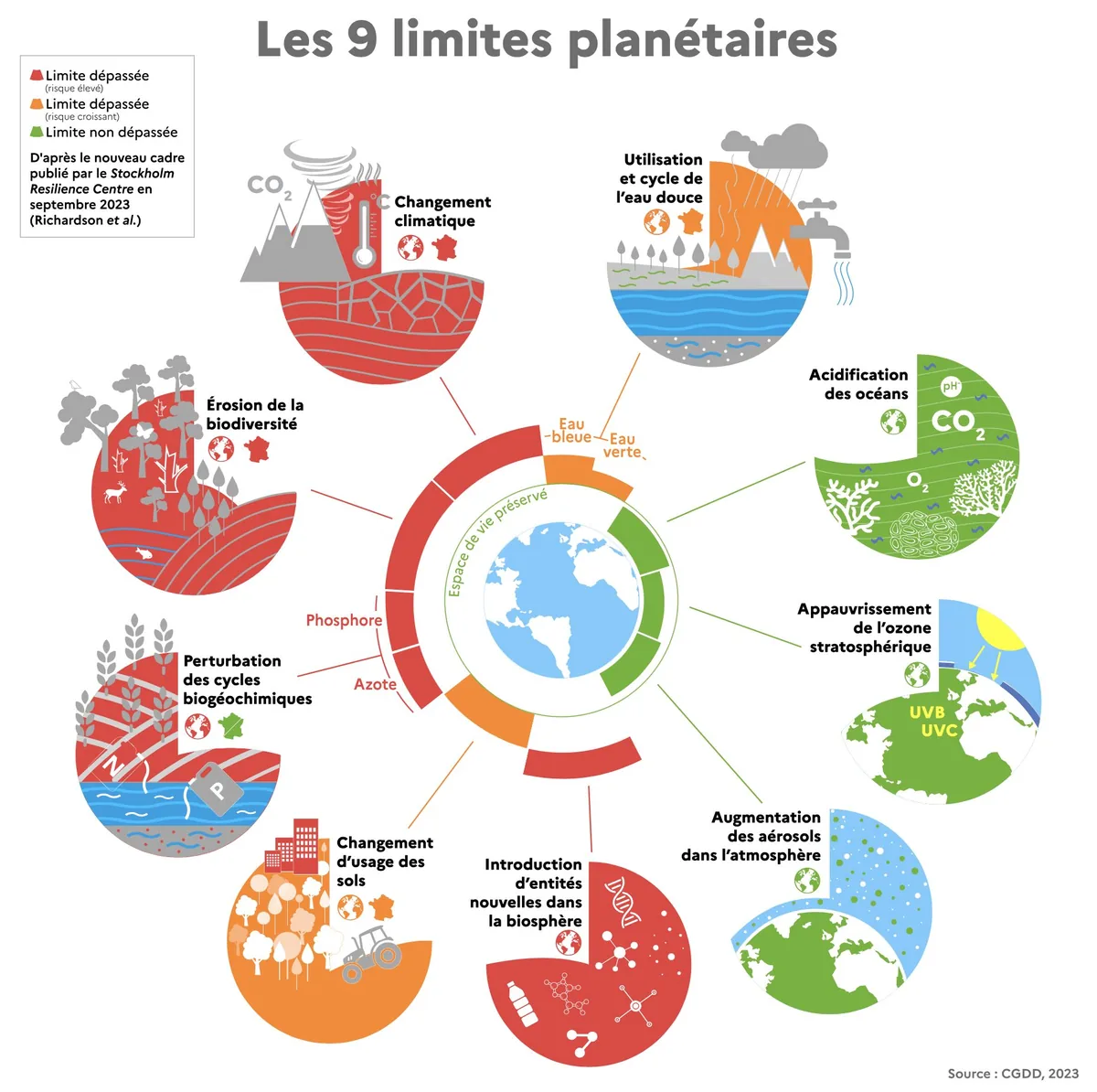
In September 2023, much of the press echoed, in a catastrophist tone, research supposedly showing that we have exceeded six of nine planetary boundaries. These boundaries are said to correspond to thresholds not to be crossed in nine domains if ecosystems are to remain within a ‘safe operating space’. They may concern the use of fresh water, the evolution of forests, the quantity of CO₂ emitted, and so on. The thesis is surprising, because the limit of a physical phenomenon marks a breaking point beyond which an object or system breaks under the effect of excessive stresses or strains. Yet, although six boundaries out of nine have supposedly been exceeded, terrestrial ecosystems still function relatively well. Barring direct destruction (as when a forest is razed), natural environments hardly ever collapse. Next, a limit refers to a quantitative value. It is the straw that breaks the camel’s back. But ecosystems are rarely confronted with threshold effects, where one would be safe on one side and in danger on the other. They evolve rather continuously, as does the danger, if it is proven. How, then, could researchers claim to define physical limits not to be crossed, at the risk of entering a danger zone? Is this not an abuse of the rhetoric of the limit (or the frontier), in order to frighten?
Update of 3 November 2026: since the publication of this article, the ‘Planetary Health Check 2025’ assessment by the Potsdam Institute for Climate Impact Research (PIK) considers that a seventh boundary, ocean acidification, has in turn been crossed: 7 boundaries out of 9 (Stockholm Resilience Centre, 24 September 2025 [1]).
A conservative vision of the environment
It all begins in 2009, when the ecologist Johan Rockström and several colleagues published a now-famous article on these supposed nine planetary boundaries [2]. They do not correspond to genuine global thresholds or tipping points, but are meant to mark the beginning of a danger zone for humanity. Crossing even one of them could set off a dynamic that, in the long run, would put humanity at risk. Why nine, and not eight or ten? The researchers do not say. In any case, they stress that they managed to quantify seven of these boundaries. They concern climate change, ocean acidification, the concentration of ozone in the atmosphere, the nitrogen cycle and the phosphorus cycle (this boundary is therefore a double one), biodiversity loss, freshwater use and land-use change or the decline of forests. To these seven quantified boundaries are added two others that are not quantified: the presence of aerosols in the air and chemical pollution. All these boundaries are interdependent, since transgressing one boundary can alter the value of another (for example, the boundary for the amount of CO2 in the atmosphere depends on forest cover). At the end of their analysis, the authors estimate that three of these boundaries (or rather two and a half) have already been exceeded: those for climate change, the nitrogen cycle and biodiversity. But how do they define the value of these boundaries?
The general idea is that parameters relating to these processes must not reach values that would endanger humanity. But while it is easy to imagine situations in which human life would no longer be possible (for example, a global temperature above 100 °C), it is much harder to determine exactly when humanity enters a dangerous zone (for example, does it begin at global warming of 1 °C, 2 °C, 3 °C or more?). To solve this problem, Rockström and his colleagues argue that the parameters must remain within ‘the range within which Earth system processes varied during the Holocene’ because, in their view, this range is a ‘scientific reference point for a desirable state of the planet’ (Rockström, p. 2). The idea is not absurd, since the Holocene is the era that begins at the end of the last ice age, some 10,000 years ago, that sees agriculture and modern civilisations develop, and that ends with the present Anthropocene. At the same time, nothing says that, if certain parameters moved outside this range, humanity would be in danger. That this period offered humanity conditions allowing its survival does not in the least mean that it offered optimal conditions for that survival, nor necessary ones. One may even doubt it, given that humanity has never prospered as much as since it left the Holocene. In other words, Rockström and his colleagues adopt a conservative position (humanity is in danger if its living conditions change too much compared with ‘ancient times’), without this conservatism being justified by empirical arguments. We are in the realm of the plausible, but not in that of the ‘scientific reference’, as they claim. Their approach even borders on religious thinking, insofar as it makes humanity’s past a sort of golden age or lost paradise. Yet it is on the basis of this vague reference to an idealised past that they define their planetary boundaries.
In 2009, with the publication of this article, the news that humanity had supposedly transgressed three planetary boundaries spread through the press, with little discussion of its relevance. The most surprising thing is that the scientific community showed little criticism and that many researchers refined this thesis without stepping back from it. A first update was then published in 2015 under the direction of the chemist Will Steffen [3]. Then, in September 2023, a new study appeared, this time under the direction of the oceanographer Katherine Richardson, announcing that humanity has now exceeded six of the nine planetary boundaries [4]. In addition to those relating to global warming, nitrogen and biodiversity, we must therefore now add those relating to phosphorus (which complements the nitrogen boundary), freshwater use, land-use change and chemical pollution. This new study naturally benefits from more than ten years of work carried out within the conceptual framework defined by Rockström and his colleagues. It therefore offers more precise analyses, takes into account the more or less critical remarks that had been addressed to it, and manages to quantify all nine boundaries [5]. But, overall, this work suffers from the same flaws as the previous one, as an analysis of the boundaries taken one by one illustrates.
The arbitrariness of the nine boundaries and climate change
With regard to global warming, Rockström and his colleagues proposed that the amount of CO2 in the atmosphere should not exceed that of the 1980s, that is, 350 ppm (parts per million). As the concentration of CO2 at the time they wrote the article was around 390 ppm, the climate boundary had already been crossed. Why was this value chosen? The reason they give is that going ‘beyond 350 ppm may lead to the crossing of a threshold that would eventually result in the disappearance of some of the major ice sheets’ (Rockström, p. 10). One can of course imagine that the disappearance of the ice sheets might have negative consequences, but that does not mean that they would be solely negative, nor that the overall outcome would be so catastrophic that humanity must be considered in danger as soon as such a disappearance seems conceivable, even in the very distant future. This is all the more so given that, to justify this highly alarmist view, the authors merely fall back on their fundamental idea that, beyond 350 ppm, the ‘contemporary climate moves outside the envelope of Holocene variability, which greatly increases the risk of dangerous climate change’ (Rockström, p. 10). That may be the case, but the choice of this threshold appears relatively arbitrary, and the danger it is supposed to define is far from demonstrated. Moreover, it implies that if humanity managed to stabilise the amount of CO2 in the atmosphere at its current level – which could be seen as a great success in the fight against global warming – humanity would still have to be considered in danger. Despite these shortcomings, Richardson and his colleagues adopt this analysis and merely point out that this boundary has been exceeded by an even wider margin, as the amount of CO2 in the atmosphere is now 417 ppm (Richardson, p. 6).
Ocean acidification
The second boundary concerns ocean acidification, which results from the dissolution of CO2 in water. It leads to a decrease in calcium carbonate or, to put it another way, a decrease in the saturation level of water with calcium carbonate. This harms calcifying organisms (corals, molluscs, crustaceans, etc.). While it is obvious that excessive acidification would be a major disruption of marine ecosystems, Rockström and his colleagues themselves acknowledge that ‘the consequences and impacts [of this acidification] are very uncertain’ (Rockström, p. 11). So how should the limit not to be exceeded be set? The researchers make a proposal that might be described as a ‘finger in the wind’ estimate. They write that, ‘as a first estimate, we propose a planetary boundary where the saturation state of ocean aragonite [a form of calcium carbonate] is maintained at 80% or more’ of the value it had in the pre-industrial era (Rockström, p. 11-12). Why 80%? A mystery. Although the aragonite saturation level varies greatly from one region of the globe to another, the average was then estimated at around 84% of its pre-industrial value. The boundary is therefore not crossed. Phew! But had the authors set it at 85%, it would have been. This clearly illustrates the element of arbitrariness in this definition of planetary boundaries. That does not stop Richardson and his colleagues from adopting the same boundary. As ocean acidification has increased since 2009, they merely note that it is ‘currently at the edge of the safe operating space’ (Richardson, p. 8). They add that ‘the trend is worsening as anthropogenic CO2 emissions continue to rise’. This is true, but this direct link between ocean acidification and atmospheric CO2 concentration suggests that the former is a redundant boundary. So why not have been content with defining eight boundaries?
The concentration of ozone in the atmosphere
For the third boundary, Rockström and his colleagues turn to stratospheric ozone, which filters the Sun’s ultraviolet rays, harmful to human health. The ozone layer must therefore not become too thin. But, here again, where should the limit be set? The researchers themselves acknowledge that they are in uncharted territory and that the characterisation of this boundary ‘is necessarily more uncertain than, for example, in the case of ocean acidification’ (Rockström, p. 12). Yet, as we have seen, the latter was already very uncertain. They nonetheless decide that the depletion of the ozone layer must not exceed 5% of the value it had in the years 1964-1980 (Rockström, p. 12). Conveniently, ‘thanks to the measures taken under the Montreal Protocol […], we seem to be on track to avoid exceeding this limit’ (Rockström, p. 12). Richardson and his colleagues can only confirm this result.
The nitrogen and phosphorus cycles
Whereas nitrogen, present in gaseous form, is part of a cycle between the atmosphere, plants and soils, phosphorus is a mineral extracted from the ground. Both are very useful for fertilising crops and are therefore used as fertilisers. But if too much of these substances runs off into rivers, lakes and oceans, mass extinctions of marine life can occur. There is therefore a risk in spreading them in excessive quantities on fields. But, as always, where should the limit be set? Rockström and his colleagues, once again, proceed by guesswork: ‘We suggest that [for nitrogen] the limit be initially set at around 25% of its current value’ (Rockström, p. 13). By default, then, nitrogen use exceeds planetary boundaries. On the other hand, they acknowledge that it ‘is difficult to quantify precisely a planetary boundary for phosphorus inflow into the oceans that places humanity at a safe distance from triggering a deleterious and widespread ocean anoxia’ (Rockström, p. 14). Despite this vagueness, they consider that the inflow of phosphorus into the ocean due to human activities ‘must not be allowed to exceed 10 times the rate’ at which it flows in without human action (Rockström, p. 14). In 2009, this limit had not been reached.
Besides this vagueness (why 25% for nitrogen and why 10 times for phosphorus?), this double boundary poses two problems. First, the effects of these two fertilisers depend on where they are used. This regionalisation makes any idea of a global limit delicate. Richardson and his colleagues do refine the approach, notably by defining a local boundary (concerning freshwater systems) in addition to the global boundary (for oceans). But this distinction does not completely remove the regionalisation objection. In any case, by proceeding in this way, they show, using recent estimates of nitrogen and phosphorus flows, that their two new boundaries (local and global) are now exceeded (Richardson, p. 9). Here, then, is one more boundary crossed. Second, the problem is that this idea of a double boundary does not take into account all the benefits of fertilisers in feeding human populations. Consequently, by reducing the use of fertilisers in order not to cross this planetary boundary, do we not risk harming human well-being?
Biodiversity loss
Regarding the loss of biodiversity, Rockström and his colleagues write that it is ‘very difficult to define a threshold level of biodiversity loss that, if transgressed for long periods, could lead to undesirable and non-linear changes in the Earth system at regional and global scales’ (Rockström, p. 15). They also consider ‘that science is not yet able to provide a limit measure that accounts, at a global level, for the regulatory role of biodiversity’ (Rockström, p. 15). Undeterred, taking the rate of species extinction as their parameter, they declare ‘that humanity has already entered deep into a danger zone where an undesirable change in the system cannot be ruled out, if the current, very high extinction rate (compared with the natural extinction rate) is maintained over long periods’ (Rockström, p. 15). As the ‘natural’ annual extinction rate is estimated, from fossils, at between 0.1 and 1.0 species per million species per year, they argue that the extinction rate should not exceed 10 extinctions per million species per year. But as the current rate, since the Anthropocene, is said to be between 100 and 1,000 times higher, the planetary boundary for biodiversity would clearly have been exceeded. Richardson and his colleagues, taking up this boundary, likewise conclude that ‘the genetic component of the biosphere integrity boundary is clearly exceeded’ (Richardson, p. 3).
Here too, this analysis raises a twofold problem. First, while global biodiversity has in all likelihood declined since the beginning of the Anthropocene, the data are more mixed at regional level, insofar as it is mainly island species that have disappeared and other species have been able to settle where the former left something of a void. A loss of biodiversity at the global level may therefore be accompanied by a gain in biodiversity at the local level. There is then little sense in defining a global limit for biodiversity. Second, it is very difficult to establish a link between biodiversity loss and a decline in humans’ quality of life. Indeed, humanity has prospered by reducing the level of biodiversity around it: by building villages, then cities, by growing crops over ever larger areas, by fighting predators, and so on. Of course, humanity should not let this biodiversity fall too far, because it provides services to humanity. But equating any decline in biodiversity with a drawback for human well-being makes no sense.
Freshwater use
The sixth boundary studied by Rockström and his colleagues concerns freshwater. It is possible to assess both the quantity of it on Earth and the quantity used by humans. Humans should not divert the available water, in particular blue water (that found in lakes, rivers and so on, as opposed to green water, which is rainwater), to the point of disrupting too much its role in ecosystems. The authors refer to the estimates of the time, which indicate that the maximum quantity of accessible blue water lies between 12,000 and 15,000 km3/year globally. On the basis of this figure, they argue that no more than 4,000 km3/year should be withdrawn. The value is plausible, but once again gives the impression of having been chosen somewhat arbitrarily. In any case, as humanity is currently said to consume only 2,600 km3/year, it would not (yet) have crossed this boundary. But, once again, it is not certain that a global boundary makes sense, insofar as it is at local level that excessive water use can have negative consequences.
As for Richardson and his colleagues, they tighten the boundary defined in 2009, so that it would have been transgressed about a century ago. But while the method of calculating the boundary is different and they now take into account both blue and green water, their approach remains the same: ‘We assume that […] a significant departure from this [Holocene] state jeopardises the functions of the freshwater Earth system.’ (Richardson, p. 7) Yet this position seems to forget that it is by transforming its environment, and therefore, among other things, the water cycle, that humanity has prospered so strongly over the last two centuries. Moreover, this boundary, presented as a biophysical boundary, does not take into account the infrastructure that humans could develop in order to use more water without harming the habitability of their environment.
Land-system change, or the decline of forests
To define the seventh boundary, Rockström and his colleagues argue that the expansion of agricultural land at the global scale could seriously undermine the capacity to regulate the climate and the water cycle. The remark makes sense, insofar as, for example, making all forests disappear would probably be very risky. But the authors then propose that no more than ‘15% of the global ice-free land surface’ should be converted to cropland (Rockström, p. 17). Why this figure? It is not clear. In any case, given that around 12% of the world’s land surface is currently cultivated, future expansion should not reach an additional 3% (around 400 million hectares) if it is to stay below this boundary. Besides this arbitrariness, the authors act as if any change in land use harms human well-being, even though the conversion of land to agriculture has clearly brought humans a great deal of well-being, if only in the form of abundant food.
Rather than taking the expansion of agricultural land as the control variable, Richardson and his colleagues now assess the destruction of forest areas. But the method is similar, since it still consists in comparing ‘the remaining forest cover with the potential area of forests in the Holocene’ (Richardson, p. 8). These researchers take care to distinguish between the different types of forest, but nonetheless consider that, on average, the reduction in forest cover relative to this reference should not go beyond 75%. Yet, according to them, this is not what is happening. A new planetary boundary has therefore been crossed.
The presence of aerosols in the air
Since the pre-industrial era, human activities have doubled the global concentration of most aerosols (particles of matter suspended in the atmosphere). These influence the Earth’s radiative balance, either directly by scattering incoming radiation back into space or indirectly by influencing the reflectivity and persistence of clouds. Aerosols also have negative effects on human health. But, as the authors acknowledge, the ‘complexity of aerosols, owing to the wide variety of particles involved, […] makes it difficult to define a planetary boundary beyond which the effects could cause unacceptable changes’ (Rockström, p. 18). They therefore reach the conclusion ‘that it is not yet possible to identify a safe boundary value for aerosol loading’ (Rockström, p. 18). Beyond this difficulty, one may still wonder whether it makes sense to try to establish a single global boundary, when the presence of aerosols varies greatly from one region to another. In any case, Richardson and his colleagues take up this idea of a boundary and quantify it, but find that it has not yet been exceeded.
Chemical pollution
Finally, chemical pollution is considered by Rockström and his colleagues to be a planetary boundary insofar as it has a global impact on the demography of humans as well as of other organisms, and therefore on the functioning of ecosystems: ‘For example, chemical pollution can influence the biodiversity boundary by reducing the abundance of species and potentially increasing the vulnerability of organisms to other stresses such as climate change.’ (Rockström, p. 18) The substances they take into account are all the novel entities introduced by humans (namely synthetic products, radioactive materials generated by humans, genetically modified organisms, and so on). But given the complexity of the effects involved, the authors consider that it is not yet possible to define quantitatively a planetary boundary for their use (Rockström, p. 19).
Faced with the difficulty of assessing this boundary quantitatively, Richardson and his colleagues nevertheless find a very simple solution. To take no risk at all, truly none, they set the limit for the introduction of these novel entities at zero, unless their harmlessness has been demonstrated. The analysis can then lead to only one conclusion: with all the ‘untested chemicals released into the environment, a novel entities boundary defined in this way is clearly transgressed’ (Richardson, p. 7). This boundary amounts to implicitly condemning industrial development for not having tested the safety of a large number of substances in the past. It is all the more questionable in that it does not weigh in the balance what these products have contributed to human well-being.
The mirage of numbers
The claim that humanity has exceeded six of the nine planetary boundaries is therefore questionable, to say the least. Not that there is no risk. The researchers working on these boundaries are right to warn us of very real dangers. But the idea that it is possible to define a clear border between one side, where humanity would be safe, and another, where it would be in danger, does not withstand analysis. The error here is to confuse scientific study with quantified study. Let us illustrate this confusion with a trivial example concerning the dangers of the road. There is no doubt that speed in a car can be dangerous. Yet it would never occur to anyone to claim that, for example, below 50 km/h using a car carries no risk, whereas above it, it is a source of danger. The absurdity of this idea shows that quantification is not synonymous with being scientific. A necessary condition for the latter is that the hypotheses be rationally justified.
Yet the fundamental hypothesis of these studies on planetary boundaries is that humanity is in danger as soon as its environment is no longer that of the Holocene. That is tantamount to saying that, as soon as a car moves, it puts us in danger. This is both true and false. True, because a moving car can cause an accident. But false, because travelling also increases our well-being. Rather than a view in terms of boundaries, it therefore seems preferable to speak of trade-offs. It would thus be desirable to recall that while fossil fuels can warm the planet too much, they have also enabled society to develop and may perhaps still play a role in that respect. Likewise, while fertilisers can cause the eutrophication of aquatic environments, they also make it possible to feed more people. While the use of fresh water can destructure ecosystems, it also increases crop productivity. While the disappearance of forests prevents, for example, the capture of carbon, it can also allow agriculture to develop. While declining biodiversity can make our planet less habitable, it is also inherent in the development of any society. Finally, while chemicals can directly endanger our health, they can also improve it. There are, a priori, only ocean acidification, the depletion of the ozone layer and the presence of aerosols that are not accompanied by positive processes for humanity. But the boundary for the first belongs to the question of global warming. The second has been halted. And the effects of the third are unclear. Rather than approaching the first six phenomena solely in a negative way, on the pretext that they take us away from Holocene conditions, a more balanced approach should therefore be adopted, so as to account also for what they can bring to humanity.
Despite its serious methodological problems, this search for planetary boundaries is not useless. Just as it is not absurd to set speed limits on the road, one can envisage establishing planetary boundaries. One just has to understand the nature of this approach. As with the road, its meaning would be political. These boundaries would therefore no longer have to be presented as ‘scientific’ or ‘physical’ limits defining two domains, one where humanity is safe and the other where it is in danger. In particular, it should no longer be claimed that it has been scientifically demonstrated that six of the nine planetary boundaries have been crossed. Instead, it will be necessary to say that objectives, which can be debated, have not been met. This conceptual clarification is a necessary condition for rational debates on the environmental situation.
References
[1] Stockholm Resilience Centre (24 September 2025). ‘Seven of nine planetary boundaries now breached’. stockholmresilience.org/news--events/general-news/2025-09-24-seven-of-nine-planetary-boundaries-now-breached.html
[2] Rockström, J., Steffen, W., Noone, K. et al. (2009). ‘Planetary Boundaries: Exploring the Safe Operating Space for Humanity’. Ecology and Society, 14(2), 32. doi.org/10.5751/ES-03180-140232
[3] Steffen, W., Richardson, K., Rockström, J. et al. (2015). ‘Planetary boundaries: Guiding human development on a changing planet’. Science, 347(6223), 1259855. doi.org/10.1126/science.1259855
[4] Richardson, K., Steffen, W., Lucht, W. et al. (2023). ‘Earth beyond six of nine planetary boundaries’. Science Advances, 9(37), eadh2458. doi.org/10.1126/sciadv.adh2458
[5] For a synthesis of the criticisms and remarks, see Frank Biermann and Rakhyun Kim, ‘The Boundaries of the Planetary Boundary Framework: A Critical Appraisal of Approaches to Define a “Safe Operating Space” for Humanity’, Annual Review of Environment and Resources, 45, 2020, pp. 497–521. doi.org/10.1146/annurev-environ-012320-080337






0 comments