Even imported and over-packaged, plant-based is the better choice!

by Jonathan Guéguen | 7 Oct 2019 | APALA Articles, Food, Climate

Reading time is .

Key points

  • Plants above all else: to reduce the footprint of our food, choosing plant-based foods comes before local, organic, zero-waste or seasonal.
  • A faraway carrot beats local meat: transport accounts for only 11% of a food’s emissions; even over-packaged, a carrot emits less than local organic meat.
  • A far more frugal plant-based parmesan: 100 g made from cashew nuts emits around 60% less CO₂ equivalent than 100 g of local organic Emmental.
  • A scientific approach, not a moral one: APALA speaks of plant-based eating; what is sustainable is what the environment could bear if everyone did it.
  • Supporting livestock farmers: livestock farming, which is very wasteful, provides only 18% of calories; it is better to help farmers produce and process pulses.
  • Cooking, the first obstacle to overcome: simple recipes, sustainable buffets and practical workshops make the shift to plant-based eating easier.

🌱 Even if it is imported and over-packaged, it is better to eat plant-based!

[ ⏱️ Estimated reading time: 2 minutes ]

🌍 The key idea
To sharply reduce the carbon footprint of our food, the most effective lever is not always the one we imagine. According to APALA, choosing plant-based foods often has more impact than choosing only local, organic or zero-waste.

🚚 Transport vs production
Contrary to popular belief, transport accounts for only a limited share of a food’s emissions. Most of it comes from production itself. So even an imported, packaged carrot can have a lower impact than a piece of local, organic, unpackaged meat.

🐄 Why animal products cost the planet more
In a food chain, the higher up the ‘trophic web’ we consume, the more energy is required. Eating an animal also entails all the energy used to produce its feed, its rearing, its emissions, its waste and the processing of the products.

🧀 Concrete alternatives
APALA illustrates this approach with a plant-based parmesan, designed as a culinary alternative but also as an awareness-raising tool. According to their comparisons, 100 g of cashew-based plant parmesan would generate around 60% less CO₂ than 100 g of organic, local emmental.

🔬 A scientific approach, not a moral one
The association prefers to speak of plant-based rather than vegan eating, in order to focus the debate on measurable impacts rather than individual morality. The question posed is simple: is a dietary practice sustainable if it is adopted by the whole population?

🌾 A social transition too
APALA stresses that the shift towards more plant-based protein could also offer prospects to livestock farmers, who are often economically vulnerable. Producing and processing pulses or other plant proteins could become a sustainable path to retraining.

🍽️ The real obstacle: cooking
For many people, the main obstacle remains a practical one: how to cook plant-based food simply, quickly and enjoyably? APALA is therefore betting on accessible recipes, workshops and sustainable buffets to support change without guilt-tripping.

#AlimentationDurable #Climat #TransitionÉcologique #CuisineVégétale #EmpreinteCarbone #LowTech #AgricultureDurable #DéveloppementDurable

🌱 Even if it is imported and over-packaged, it is better to eat plant-based!

[ ⏱️ Estimated reading time: 2 minutes ]

🌍 The key idea

In this interview, APALA points out that food weighs very heavily in our carbon footprint. To reduce our impact effectively, the most powerful lever remains choosing plant-based foods.

🥕 Local, organic, zero waste… but not at any price

Limiting packaging, buying local, choosing organic and respecting the seasons all remain good practices. But they are not always enough. According to the data cited, the production of a food accounts for most of its emissions, far more than its transport. An imported, packaged carrot can therefore have less impact than local, organic, unpackaged meat.

🐄 Why animal products weigh heavier

Eating an animal product also means taking into account all the energy needed to feed, rear, process and transport it. The higher up the food chain we go, the more water, land and carbon are used. Dairy products and eggs are also concerned, even though not all livestock farming has the same impact.

🔬 A scientific approach, not a moral one

APALA prefers to speak of plant-based rather than vegan eating. The aim is not to judge individual choices, but to compare environmental impacts. The real question is one of sustainability: if everyone adopted this practice, could the planet absorb it?

👩‍🍳 Simple, concrete solutions

To make change easier, APALA is betting on accessible recipes, workshops and low-tech alternatives, such as its plant-based parmesan. The challenge is not only to convince people, but to help everyone cook differently, without losing any enjoyment.

#AlimentationDurable #Climat #CuisineVégétale #TransitionÉcologique #LowTech #ConsommerAutrement #Végétal

🌱 Even if it is imported and over-packaged, it is better to eat plant-based!

[ ⏱️ Estimated reading time: 2 minutes ]

🌍 The findings
To reduce the environmental footprint of our food, the most powerful lever remains choosing plant-based foods. Local, organic, zero-waste and seasonal all matter, but they do not always offset the high impact of products from livestock farming.

🥕 The idea that shakes things up
Even imported and packaged, a carrot can have a lower carbon impact than local, organic, unpackaged meat. Why? Because production weighs far more heavily than transport in the climate footprint of food.

📊 The weight of production
According to the data cited, transport would account for around 11% of a food product’s emissions, compared with 83% for its production. In livestock farming, the impact comes in particular from animal feed, digestive gases, waste, processing and sometimes deforestation.

🔁 The energy logic
The higher up the food chain we eat, the more energy, water and resources are needed. Eating plants directly is therefore generally more efficient than eating animals that have themselves eaten plants.

🧀 Concrete alternatives
APALA champions simple, accessible solutions, such as plant-based Parmesan, to show that it is possible to reduce one’s impact without giving up on taste. The aim is not to make people feel guilty, but to inform and to make the shift towards a more sustainable diet easier.

👩‍🍳 The real challenge
The main obstacle often remains the kitchen: a lack of time, ideas or habits. Hence the importance of easy recipes, workshops and low-tech tools to make plant-based eating desirable, practical and part of everyday life.

#AlimentationDurable #MangerVégétal #Climat #Écologie #TransitionAlimentaire #LowTech #CuisineVégétale #EmpreinteCarbone #ConsommerAutrement #Planète #Végétal #Sobriété #AlimentationResponsable

Published in issue #21, Alimentation durable: Brisons nos chaînes alimentaires !

Our interview, held when we met Le Magazine les Autres Possibles (MAP to its friends), was published under this slightly provocative title. Of course, it is best to avoid packaging as much as possible and to favour local produce, but not at all costs, as we shall see here…

But first, we warmly thank the MAP for allowing us to share this piece so that as many people as possible can read this interview, ahead of a new article that also covers the subject (but let’s say no more!). If you don’t yet know the magazine, run and buy it, it’s only €2! Not much for independent journalism, is it? Like this issue (#21), it offers fine pieces on the contemporary subjects that preoccupy us. Luckily, all issues are available for sale on their website here.

Banner of issue no. 21 of the magazine Les Autres Possibles, ‘Brisons nos chaînes alimentaires !’

Interview by Marie Bertin (Editorial Coordinator at MAP)

APALA first looked at the problem of heating, inventing the ‘Poêle Fusée à Inertie’, before developing a plant-based parmesan recipe… Did you get hungry along the way?

Not at all! Our calling is to find concrete technical solutions to environmental problems. We first analysed what the main sources of energy expenditure for an individual are: heating accounts for more than 60% of the energy consumed in France. Hence the development of a high-performance ecological masonry heater. But we quickly realised that, from the point of view of a person’s overall carbon footprint, once all production cycles are taken into account, food is the biggest contributor! It accounts for a quarter of an individual’s carbon footprint, according to the latest report from ADEME (1), the French Agency for the Environment and Energy Management. So we started working on low-tech solutions in this area: plant-based parmesan is one of them!

Is cheese a particular problem? Please reassure us…

No, but animal-based cheese is part of the wider problem of the environmental impact of foods derived from livestock farming. Our parmesan is a genuine alternative, as well as a tool for raising awareness: it serves as an example to set out and compare the carbon footprints of different types of food. For the conclusion of all our research is that, to significantly reduce the ecological footprint of our diet, plant-based foods must come first, before anything else. Zero waste, organic, local and seasonal are, of course, good and important. We also think it’s absurd to wrap a carrot in plastic. But if you compare the available data on the carbon footprints of different production chains, there is no ambiguity: even over-packaged, even coming from the other side of the world, a carrot will always have less impact than an unpackaged piece of meat, produced locally and organically.

How could a product from the other side of the world be less energy-intensive than a local one?

You need to grasp how the ‘trophic network’ works [see infographic]: the way energy flows through the different food chains. At level 1 are the autotrophs: plants, which are able to produce organic matter from nothing more than sunlight, water and minerals. Humans and animals in general are not. They belong to another level: that of the heterotrophs. We are therefore dependent on the former. Whatever we eat, plants were needed at some point in the chain: whether we eat them directly, eat animals that ate plants, or animals that ate animals that ate plants. So the higher up a food chain the link you eat, the more you ‘cost’ in energy. Let’s take an example: if you eat a carrot, water and carbon were needed to produce it. If you eat the rabbit, water and carbon were needed for the rabbit, plus the water and carbon needed to produce the carrots the rabbit ate, and so on.
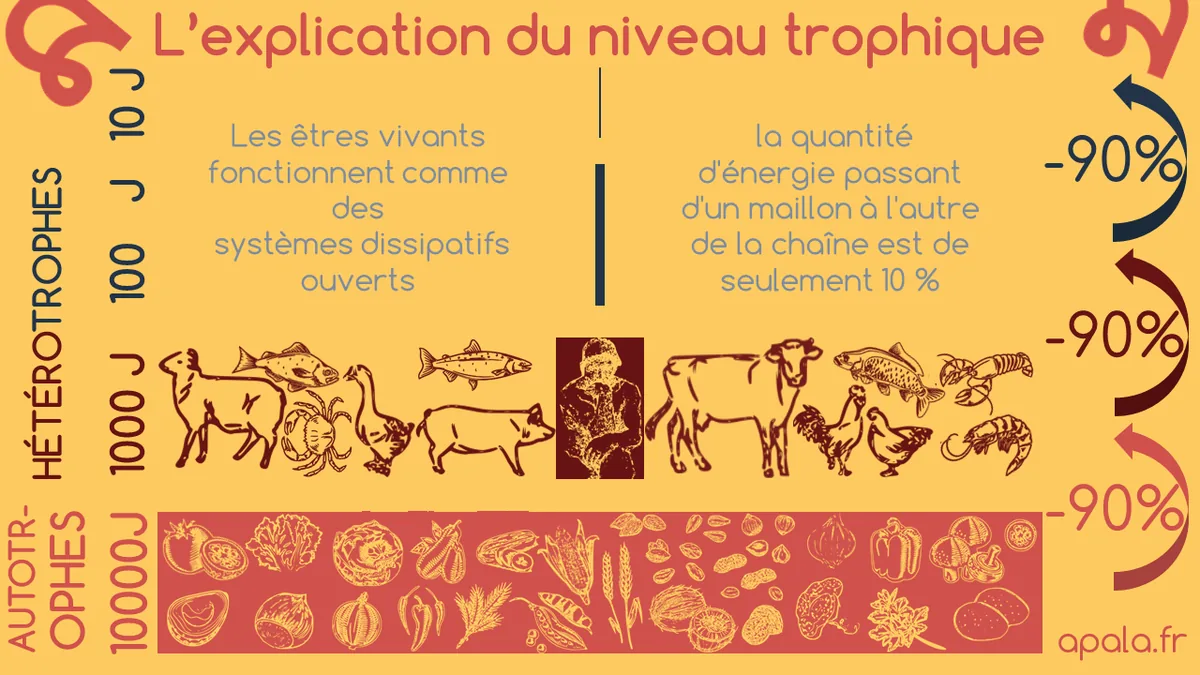
Trophic levels: at each link in the food chain, 90% of the energy is lost, from 10,000 J (plants) to 10 J

Doesn’t the impact of transport reverse this relationship?

No. Contrary to popular belief, according to one of the main studies on emissions linked to the food system (2), carried out in the United States, transport accounts for only 11% of the greenhouse gas emissions of a food product. 83% is due to the production phase itself. In the case of livestock farming, this impact is mainly linked to the animals’ digestive gases, their manure, the growing and transport of their feed, deforestation, and the processing of meat and dairy products, among other things.

Transport (‘Transport’) and packaging (‘Packaging’) weigh little: for one kilo of beef, transport accounts for 0.5 kg of CO₂ equivalent out of 99.5. What we eat, more than where it comes from, determines the carbon footprint. Source: Poore, J. et Nemecek, T. (2018), « Reducing food's environmental impacts through producers and consumers », Science, 360(6392), 987-992. Chart by Our World in Data, in English; data subject to the conditions of their producer.

Should a farmed cow be put on the same footing as a hen that eats our peelings in the garden? In other words, why advocate a return to an entirely plant-based diet, without making any exceptions?

That’s true. If we rank animals, the hen is far more energy-efficient than the calf, for example. The calf is the most energy-intensive of all! That said, the hen is still more energy-intensive than any plant… That’s just how it is. Yet scientists tell us that we are currently living through the sixth mass extinction, 100 or 1,000 times faster than previous ones. We are the cause, and we do not know whether life will survive it. Point taken! It seems vital to stack every possible chance in our favour: in other words, to limit our impact as much as possible.

You rely on a great deal of figures. But in the field of impact studies, calculation methods are controversial…

Even if we criticise the studies, we can agree that the impact of an animal product outweighs that of its plant-based equivalent. For example, 100 g of plant-based parmesan made with cashew nuts produces around 60% less CO₂ equivalent than 100 g of organic, local emmental. The same goes for water consumption.

If we follow your reasoning, milk and eggs must also have a major impact. Yet you speak of plant-based eating, not veganism. Why is that?

We prefer to speak of plant-based eating because our approach to the subject is scientific, not moral. As soon as we talk about veganism, we point to the ethical debate. We are not here to dictate people’s consciences. Our research serves to compare the impacts of different foods and to inform the public. Any action inevitably has an impact. Our starting question is: when it comes to food, what level of impact is sustainable for the planet? In our view, an action is sustainable if it can be generalised: if we all did it, could the environment bear it?

Our food choices also have social consequences. What do you say to livestock farmers who defend their expertise?

We understand livestock farmers. But we think that putting the emphasis on plant-based foods is also a solution for them. In our view, the current model of livestock farming is highly wasteful: the energy expended is enormous compared with the energy produced. Livestock farming would provide only 37% of the protein and 18% of the calories we consume(3). Moreover, many farmers live below the minimum social benefit level. They have the highest suicide rate of any socio-professional category. Why would we want to carry on like this anyway? In short, to get farmers out of their situation, in my view, we need to help them make a change of direction and, why not, become processors: produce more plant proteins (pulses of all kinds) and take part in their processing.

What low-tech solutions do you propose to make it easier to change our eating habits?

We asked people: the number one obstacle for most is cooking. ‘Fine, but I don’t intend to spend hours in the kitchen, and so on.’ In other words, what we need is to relearn how to cook certain foods, and to have ideas for simple, tasty recipes! As well as developing and sharing recipes, APALA organises sustainable buffets and cooking workshops.

Find a first introduction to plant-based cooking on the back of the magazine, available here:

> #21 Alimentation durable: Brisons nos chaînes alimentaires ! <

References

(1) Barbier, C., Couturier, C., Pourouchottamin, P., Cayla, J.-M., Silvestre, M. and Pharabod, I. (2019). L’empreinte énergétique et carbone de l’alimentation en France. De la production à la consommation. Club Ingénierie Prospective Énergie et Environnement (CLIP), Iddri, with the support of ADEME. hal.inrae.fr/hal-04177325v1

(2) Weber, C. L. and Matthews, H. S. (2008). ‘Food-Miles and the Relative Climate Impacts of Food Choices in the United States’. Environmental Science & Technology, 42(10), 3508-3513. doi.org/10.1021/es702969f

(3) Poore, J. and Nemecek, T. (2018). ‘Reducing food’s environmental impacts through producers and consumers’. Science, 360(6392), 987-992. doi.org/10.1126/science.aaq0216

Guidance: what if AI governed us through good advice?

In Le Point, Thomas Lepeltier presents Antoine Buéno’s ‘Guidance’: the danger of AI would be less that it exterminates us than that it advises us too well. Our summary in three arguments.

Wildfires of summer 2026: what the global data say

In Causeur, Thomas Lepeltier compares the exceptional wildfires of summer 2026 in France with global satellite data, which describe a rather calm year. Our summary in three arguments.

Does organic farming keep its promises? Naturalness put to the test of the facts

In Atlantico, Thomas Lepeltier challenges the founding principle of organic farming, the preference for the natural over the synthetic, and judges its record to be more nuanced than its image. Our summary in three arguments.

A future without suffering? A video to open the debate

With The Flares, APALA offers a short foresight video: what if reducing avoidable suffering, among humans and other animals alike, were one of the great undertakings of the century?

Biodiversity: a public exchange with Tatiana Giraud

In Causeur, Thomas Lepeltier criticised the way Tatiana Giraud presents biodiversity; she replied, and he responded in turn. Our summary of the three texts: arguments, quotations and questions for debate.

Performance or robustness? Olivier Hamant’s thesis challenged

In Le Point, Thomas Lepeltier challenges the opposition between performance and robustness defended by the biologist Olivier Hamant: in his view, the resilience of societies comes from innovation and efficiency. Our summary in three arguments.

Natural or synthetic? What the ban on copper says about organic farming

In Causeur, Thomas Lepeltier draws a lesson from the withdrawal of copper-based fungicides decided by Anses: judge each product by its effects, not by whether it is natural or synthetic. Our summary in three arguments.

AI and extinction: Yudkowsky and Soares’s thesis in question

In Le Point, Thomas Lepeltier examines the thesis of Eliezer Yudkowsky and Nate Soares that a superintelligent AI would exterminate humanity. Our summary in three arguments.

Climate: why Bill Gates’s change of tone deserves to be welcomed

In Causeur, Thomas Lepeltier analyses Bill Gates’s change of tone on climate: not a repudiation of science, but a reminder that poverty and disease remain the greatest threats. Our summary in three arguments.

Sufficiency: a critique of Philippe Bihouix’s vision

In Le Point, Thomas Lepeltier responds to Philippe Bihouix: choosing sufficiency from today underestimates our capacity to innovate, and abundance would be the condition for sustainability. Our summary in three arguments.

0 comments

Trackbacks/Pingbacks

  1. Vite, la nouvelle transition alimentaire ! — APALA - […] Even when imported and over-packaged, it is better to eat plant-based! […]

make a donation!

Public-interest association: €10 from you means nearly €30 for us, after tax relief.

Understand how it works