
Shifting diets towards plant-based foods
What the most recent data says, ten proposals for territorial food projects, and our copyright-free infographics, ready to use in your own materials.
Page updated on 2 November 2026: it will evolve as new data becomes available.
The essentials in four figures
Each figure has been checked against its source, cited at the bottom of the page. The infographics below give more detail.
A vegan diet emits around four times fewer greenhouse gases than a meat-rich diet.
Actual diets of 55,504 people in the United Kingdom (Scarborough et al., 2023).of the world’s agricultural land is used for livestock farming, which provides only 17% of our calories.
FAO, via Our World in Data (2024).of meat per person per year in France in 2025: almost as much as in 2015, whereas climate scenarios aim for 20 to 70% less by 2050.
Agreste, 2026; I4CE, 2023.of fibre per day on average among adults, against a recommended 30 g: pulses, wholegrain cereals, fruit and vegetables are missing from our plates.
Anses, INCA 3 and 2016 opinion.Climate and animal suffering: which products weigh the most?
Climate is only part of the impact of what we eat: producing meat, milk or eggs also means keeping animals in farms, sometimes for thousands of hours for a single meal. This tool ranks ten animal products according to the priority you give to each of the two issues.
What the score measures
- Animal suffering: the number of hours animals spend on farms to produce 2,000 kcal (roughly a day’s energy) of each product, weighted if you wish by the intensity of suffering specific to the species.
- Climate: greenhouse gas emissions (in kg CO2 equivalent) for those same 2,000 kcal, based on life-cycle analyses.
- The two are combined according to your priorities, then scaled from 0 to 100. The score compares products with one another: it is not an absolute measure of harm.
Its limitations
- Data that is mainly American and international (farming durations, yields, USDA nutritional values, emissions drawn mostly from 2011 life-cycle analyses, American and, for prawns, Chinese), not yet adapted to France.
- Strong assumptions about the sensitivity of species, in particular fish and prawns, and about elasticity.
- Not counted are ‘secondary’ animals (male chicks, calves, fish used in fishmeal), nor health, nor other environmental harms.
- Level of evidence: not assessed by APALA. This is a tool for reflecting on one’s choices, which its author himself does not present as an exact measure.
Towards a suffering footprint
The carbon footprint has made the impact of our choices on the climate visible. We want to do the same for animal suffering: a ‘suffering footprint’ that sets side by side, for a meal or a diet, its cost to the climate and to animals.
This tool offers a first glimpse. We would like to develop it into a calculator based as far as possible on French data: this is a line of work for APALA, yet to be built.
Food impacts is a popularisation tool. Most of the research on measuring the suffering of farmed animals is carried out by the Welfare Footprint Institute, which estimates the duration and intensity of the pain experienced by animals in different farming systems: this is the scientific basis on which we want to build.
In France, Data for Good is preparing, with Anima and drawing on the work of the Welfare Footprint, an ‘Empreinte souffrance’ website: data, visualisations, a calculator and integration with Open Food Facts, starting with hens. It is expected to launch in the coming months.
Adapted from Food impacts (foodimpacts.org), by Ville Sokk, under the MIT licence. Same data and same calculation as the original tool, translated into French. Method, sources and frequently asked questions: foodimpacts.org/methods.
More explanations on Food impactsWhere does France stand?
The law sets a baseline for catering in public institutions, but France still has no quantified target for reducing meat consumption. Local authorities therefore have real room for manoeuvre.
One vegetarian menu a week at school
Mandatory since the Égalim law (2018), made permanent by the Climat et résilience law (2021). Complied with by 96.7% of school canteens that responded to the review.
Égalim review 2025 (2024 purchases).A vegetarian option every day
Mandatory since 2023 in State catering only, where there is a choice (complied with by 65.8% of the restaurants that responded). For local authorities, the 2021–2023 trial was not extended: it is a local decision.
Climat et résilience law, art. 252; Égalim review 2025.50% sustainable products, including 20% organic
The Égalim target, in force since 2022, is far from being met: 29.5% sustainable and quality products and 11.8% organic in 2024.
Égalim 2025 review.The national strategy (SNANC, 2026)
It provides for ‘limiting’ meat and charcuterie, especially imported, and for increasing fruit, vegetables, pulses and nuts, with no quantified target and no binding force.
SNANC, 11/02/2026 (Maire-info).460 projets alimentaires territoriaux
Created by the 2014 law, the PAT cover a large part of the country, but State support for operational PAT was halved between 2024 and 2025.
Maire-info, 12/02/2026.The benchmarks of Santé publique France
Pulses at least twice a week, a handful of nuts a day, wholegrain starchy foods, and no more than 500 g of meat (excluding poultry) and 150 g of charcuterie per week.
Repères du PNNS, 2019.Dix propositions pour un projet alimentaire territorial
They draw on those we have been putting to local authorities since 2022, updated with the legal framework and the 2026 data. Each can be adapted to the size and priorities of the area.
Set a quantified target for shifting diets towards plant-based foods in the PAT
The national strategy (SNANC, February 2026) calls for ‘limiting’ meat and increasing plant-based foods, without any figures. Yet carbon neutrality scenarios assume 20 to 70% less meat per person by 2050.
In practice: The area can set its own trajectory (for example: share of plant proteins in meals served, pulses on the menu, meat purchases), with a progress review every year.
Sources: SNANC 2026; I4CE, 2023; Agreste, 2026.Go further than the weekly vegetarian menu
The weekly vegetarian menu is applied by 97% of school canteens that responded. The daily vegetarian option is compulsory only in State catering, but nothing prevents a local authority from offering it: Anses found no nutritional reason to limit the frequency of vegetarian meals at school.
In practice: Two vegetarian menus a week, or a vegetarian option every day wherever there is a choice, starting with volunteer sites.
Sources: Égalim review 2025; Climat et résilience law, art. 252; Anses, 2021.Make the protein diversification plan a real tool
Compulsory above 200 covers a day, this plan often remains a formality. Yet it is the right framework for planning pulses, recipes and purchasing.
In practice: Link it to the PAT’s objectives, track it on the ma-cantine platform and make it public.
Source: Égalim law, 2018.Train and equip kitchen teams
A vegetarian dish gets chosen first and foremost because it is good, generous and well presented: this is what trials in real restaurants show.
In practice: Training for chefs (specialist associations such as Assiettes Végétales), recipe sheets, sharing between sites; draw on our page ‘Faire choisir le végétal en restauration’.
Source: WRI, 2024 guide (90 techniques assessed).Apply the techniques that get people to choose plant-based dishes
Place the plant-based dish first, name it by its flavour rather than as ‘meat-free’, make it the default option: these levers have been tested and ranked by the World Resources Institute.
In practice: Choose three or four priority techniques, test them at a few sites and measure diners’ choices.
Source: WRI, 2020 and 2024.Less meat to fund quality
Purchases by institutional catering remain far from Égalim’s targets: 11.8% organic and 29.5% sustainable and quality products in 2024, against targets of 20% and 50%. Serving fewer animal products frees up budget for better-quality products, including the 60% of sustainable meat and fish required since 2024.
In practice: Write this ‘less but better’ approach into public procurement contracts and monitor its effect on the cost of meals.
Sources: Égalim review 2025; Climat et résilience law; ADEME, Transition(s) 2050.Measure the footprint of meals
According to ADEME data, a beef meal emits around nine times more than a vegan meal: what we eat matters far more than where it comes from (transport accounts for around 6% of food-related emissions).
In practice: Display the carbon footprint of menus using public tools (Agribalyse, Impact CO2) and track it in the PAT review.
Sources: ADEME, Impact CO2 (Agribalyse 3.2); Poore and Nemecek, 2018.Build local pulse supply chains
Institutional catering is a stable outlet for lentils, chickpeas or beans grown close to home, and for their processing (flours, pasta, ready meals).
In practice: Multi-year contracts with producers, shared processing facilities, local pulses on the menu every week.
Source: PNNS benchmarks (pulses at least twice a week).Support livestock farmers who want to change
Some livestock farmers are looking for another path, and cattle numbers have already fallen by 15% between 2016 and 2024. Helping them diversify is better than simply enduring this decline.
In practice: Farm assessments, investment aid, outlets guaranteed through public procurement, with organisations specialising in farm transition.
Sources: Agreste, livestock 2024; Cour des comptes, 2023.Inform residents without making them feel guilty
53% of French people say they have reduced their meat consumption over the past three years, and a majority think the State does not provide enough information about the alternatives. Local outreach matters.
In practice: Workshops, tastings, plant-based menus at public events, and our copyright-free infographics in your materials (magazine, posters, website).
Source: Réseau Action Climat and Toluna Harris Interactive, 2025.Getting diners to choose plant-based dishes in catering
Our interactive page presents the 90 techniques assessed by the World Resources Institute to help diners choose a plant-based dish: ratings from 49 experts, results of trials in real restaurants, detailed sheets and 18 priorities.
- For central kitchens, and corporate and university restaurants
- In French and English, on computer and phone
- Presented at the Hack the Fork workshop (AgroParisTech, October 2026)
Our copyright-free infographics
Verified figures, designed to be understood at a glance. Cities, metropolitan areas, canteens, associations, teachers: use them in your magazines, posters, websites and presentations.
CC BY 4.0 licence: you can share, print and embed them freely, including in institutional materials, crediting ‘Infographie APALA, apala.fr’. Need another format, a version in your colours or a local update? Write to us.
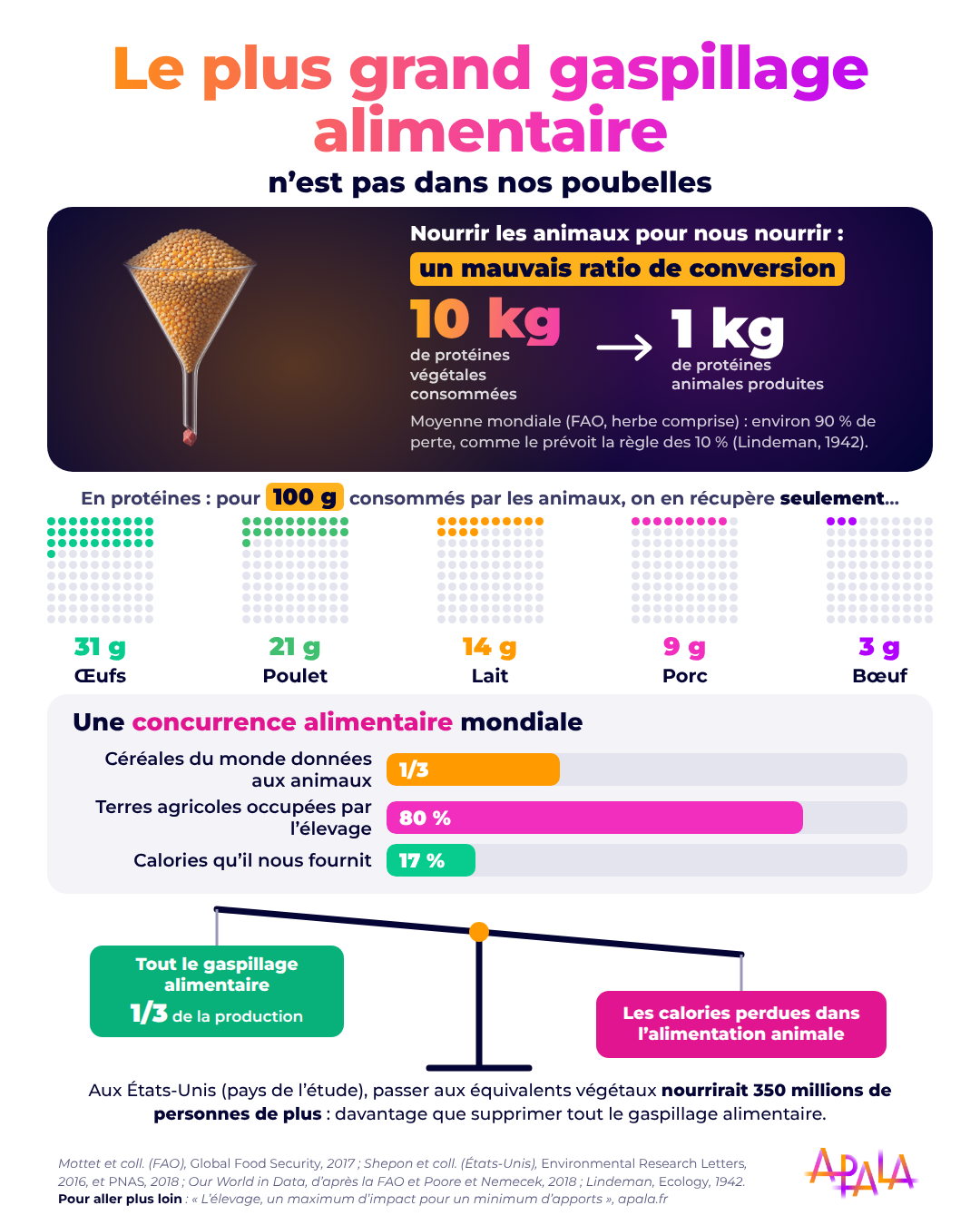
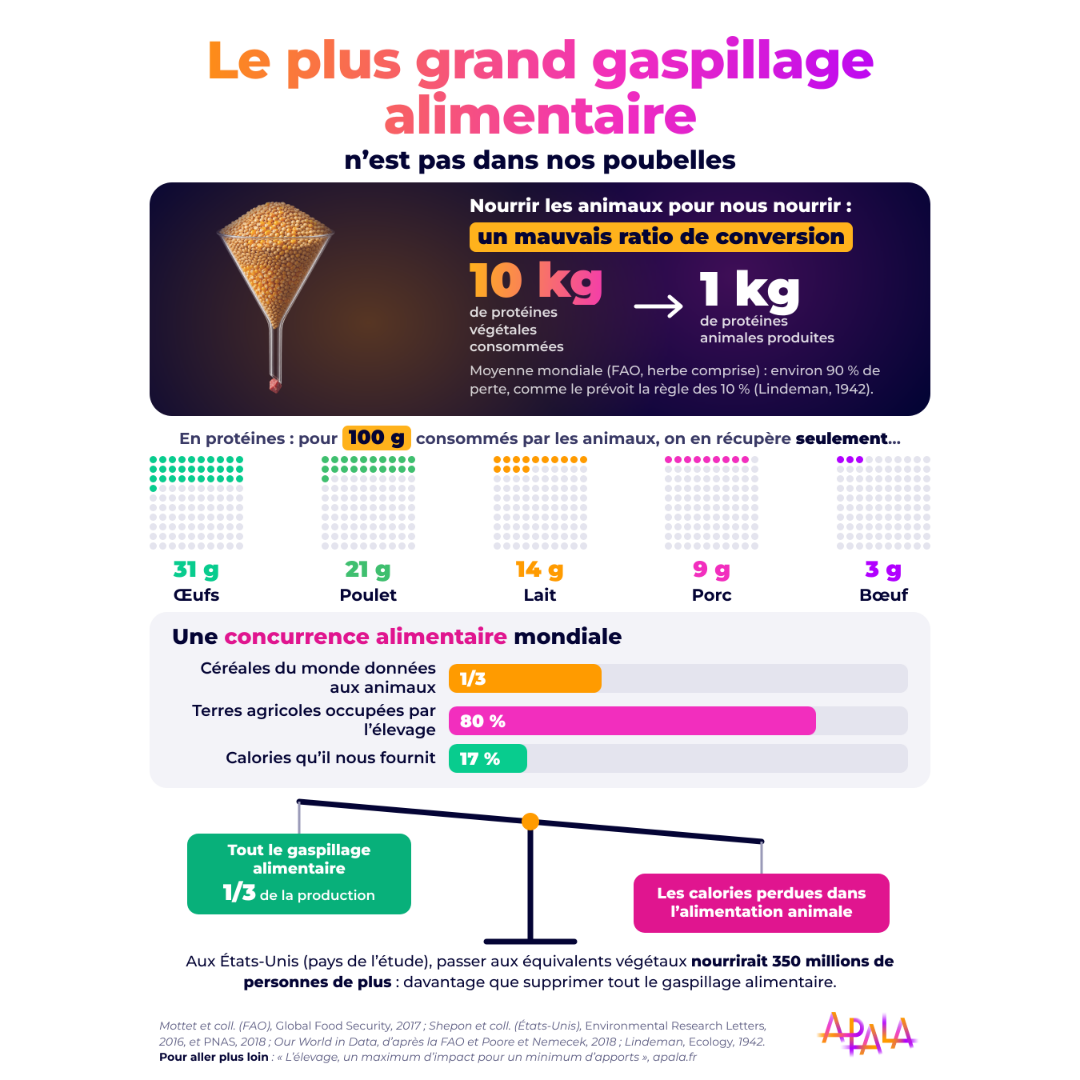
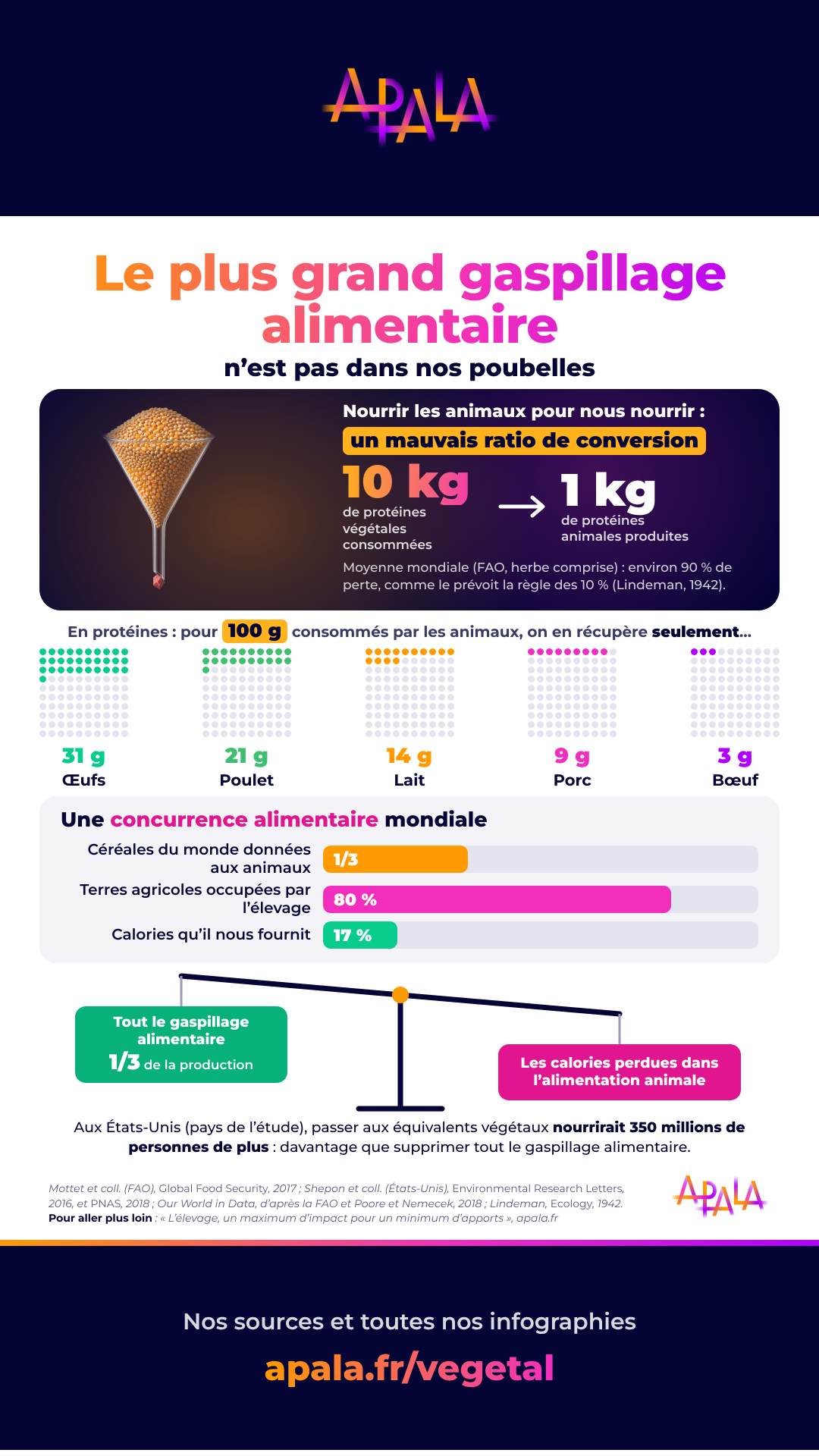
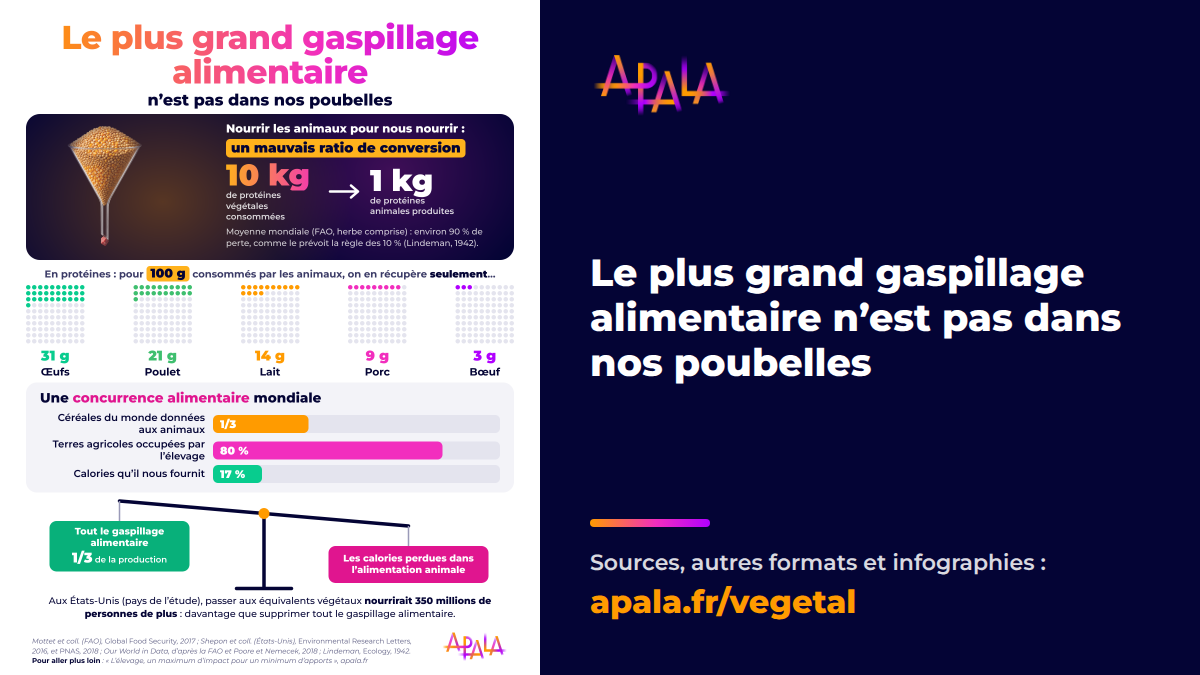
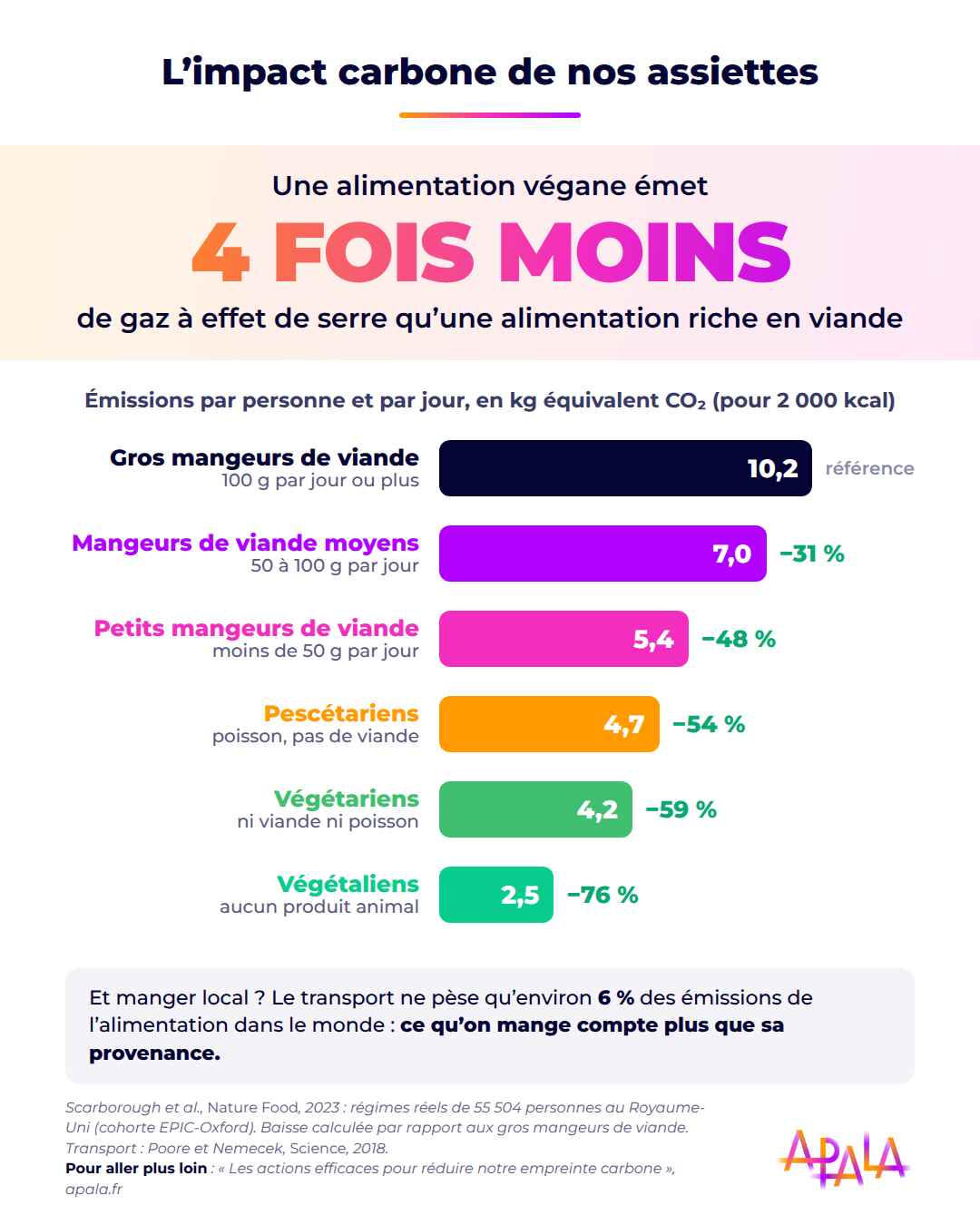
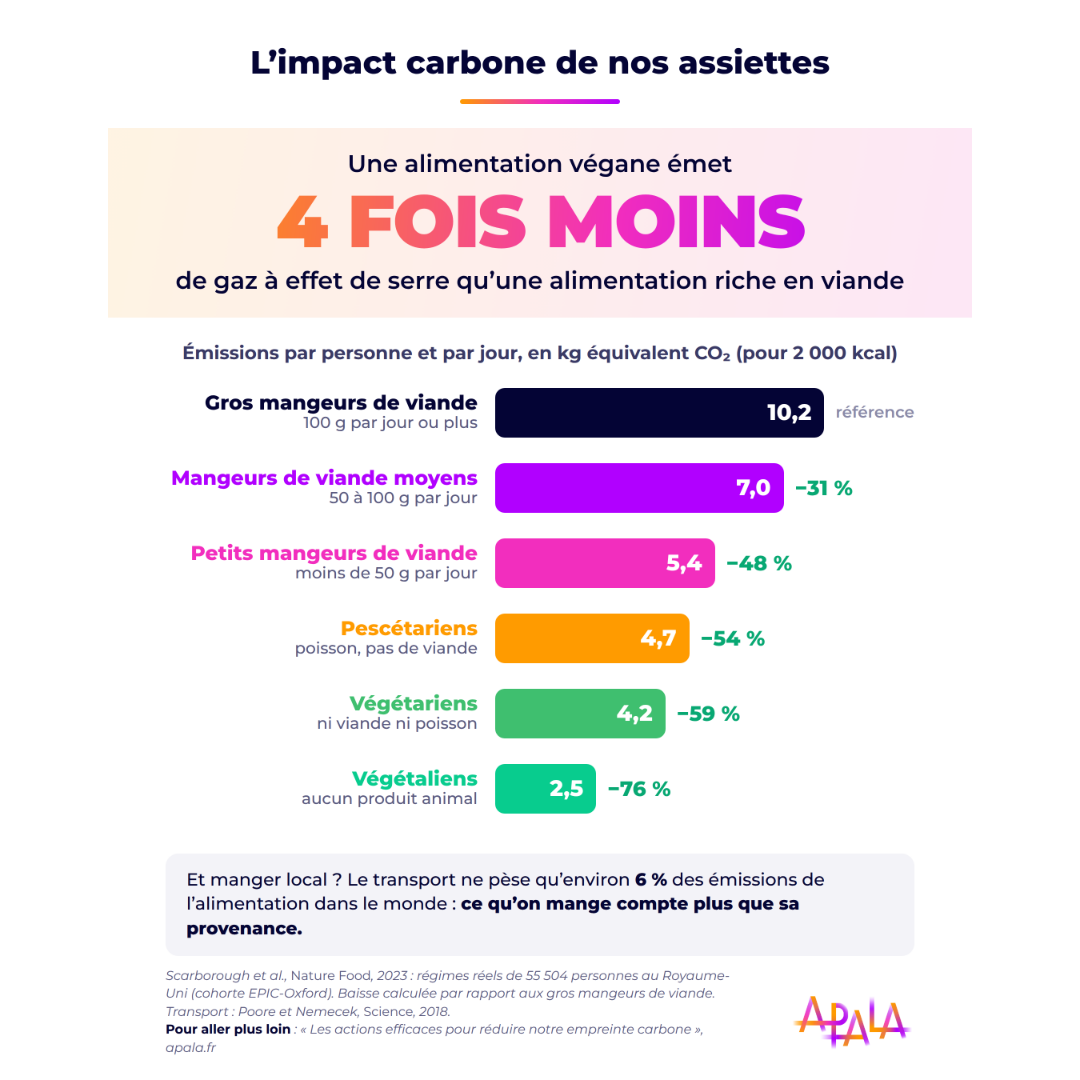
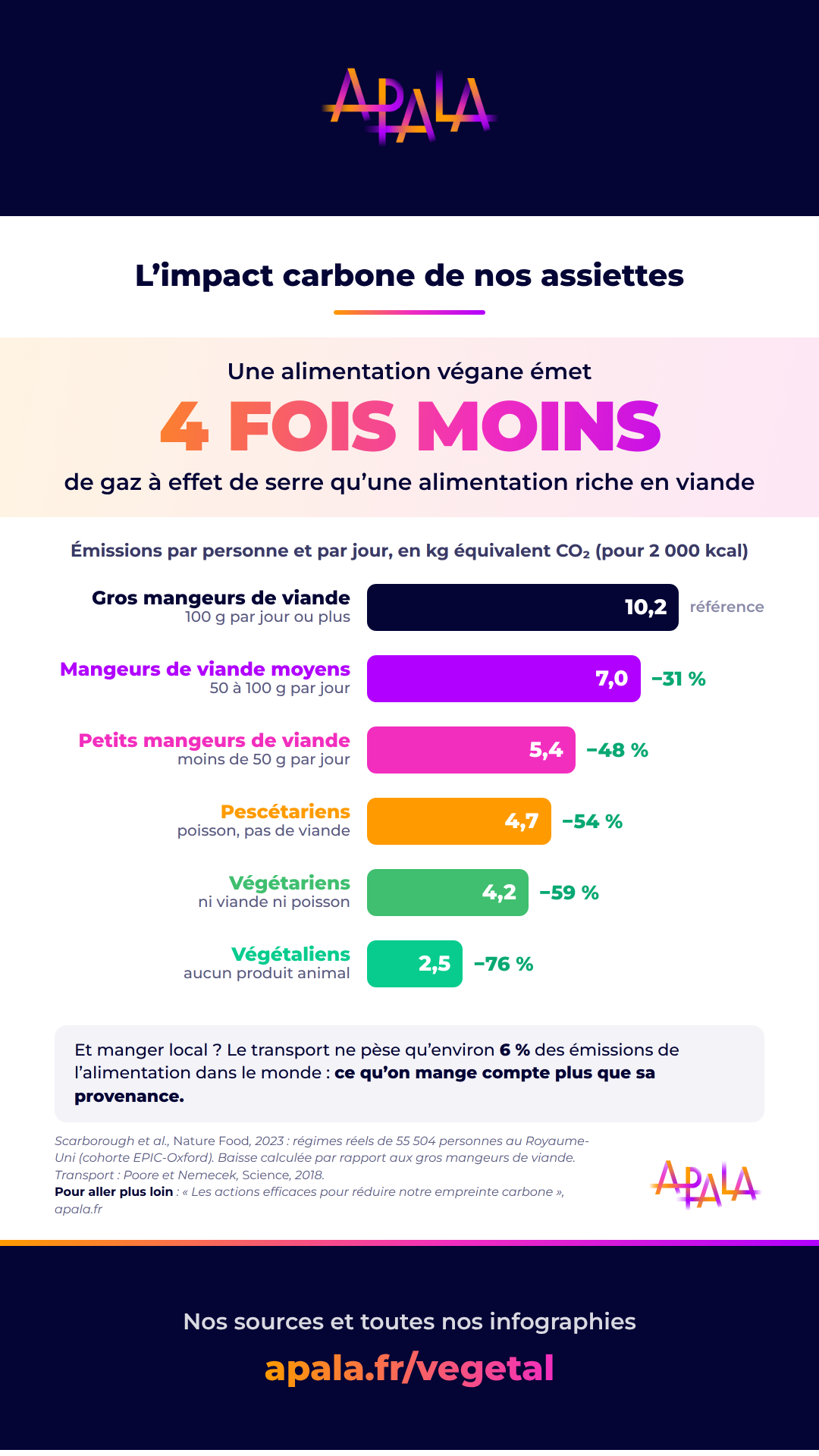
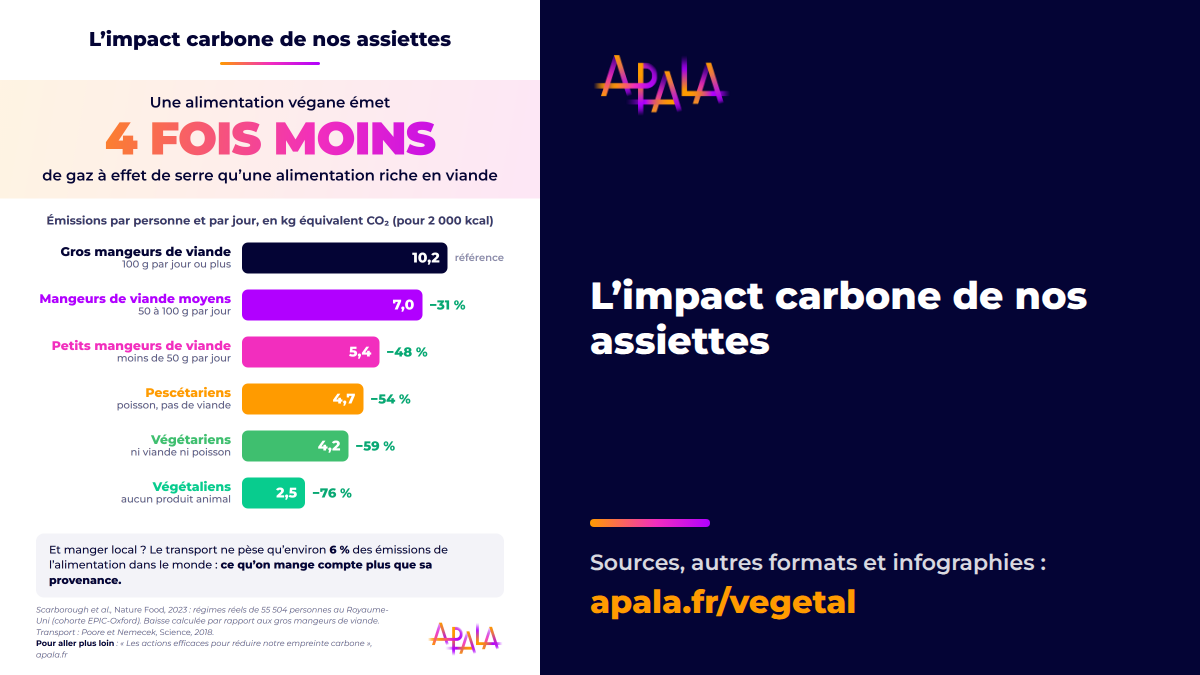
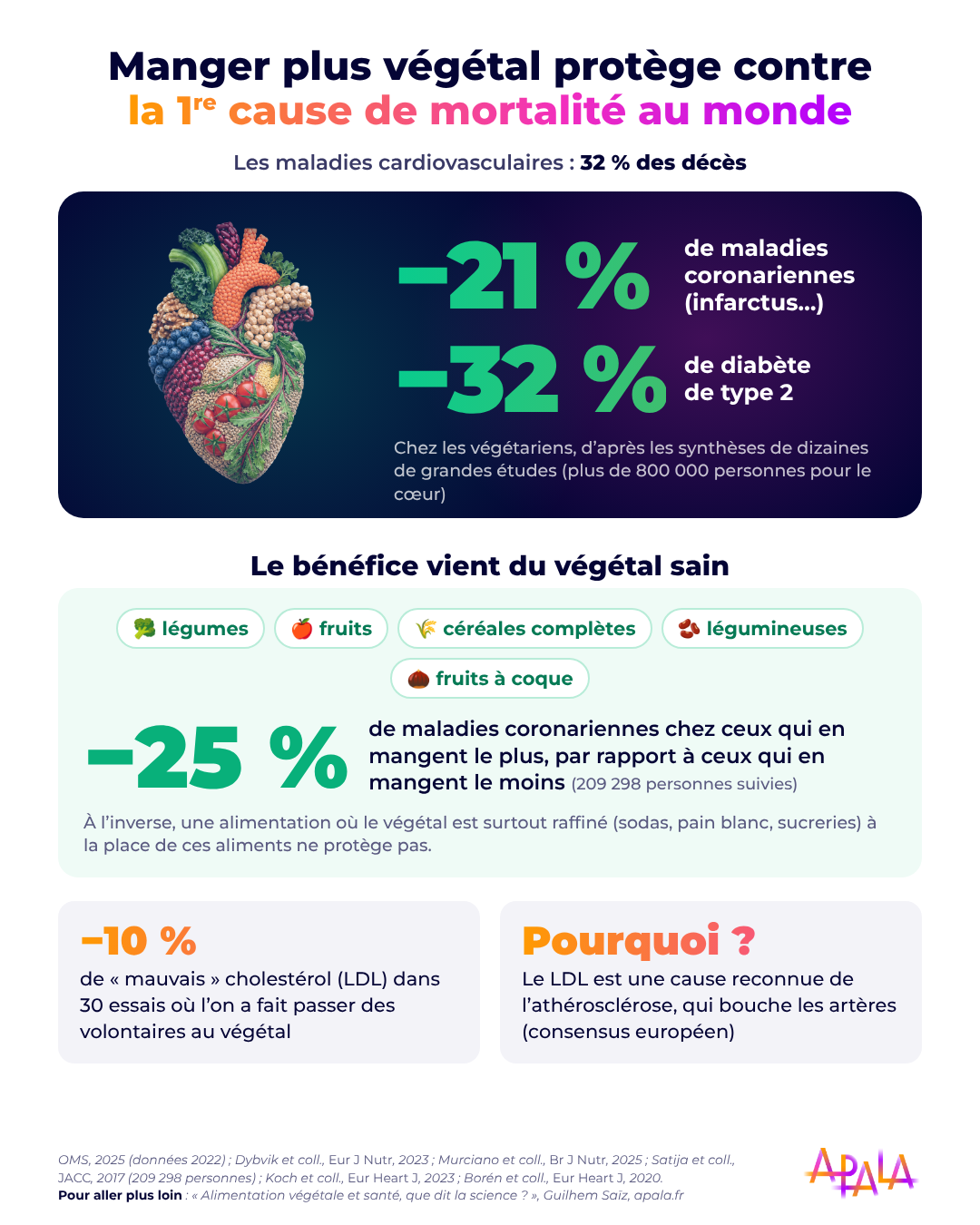
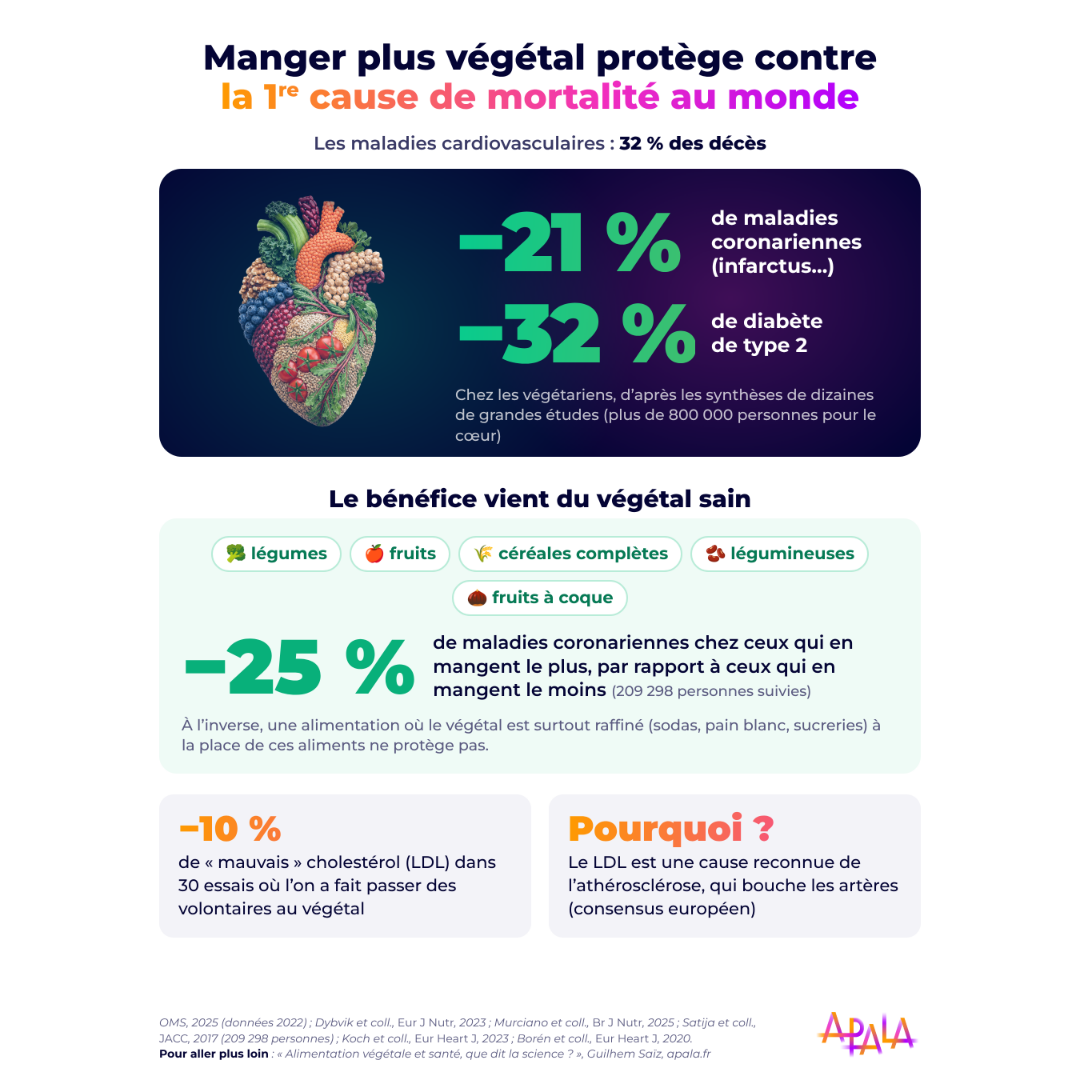
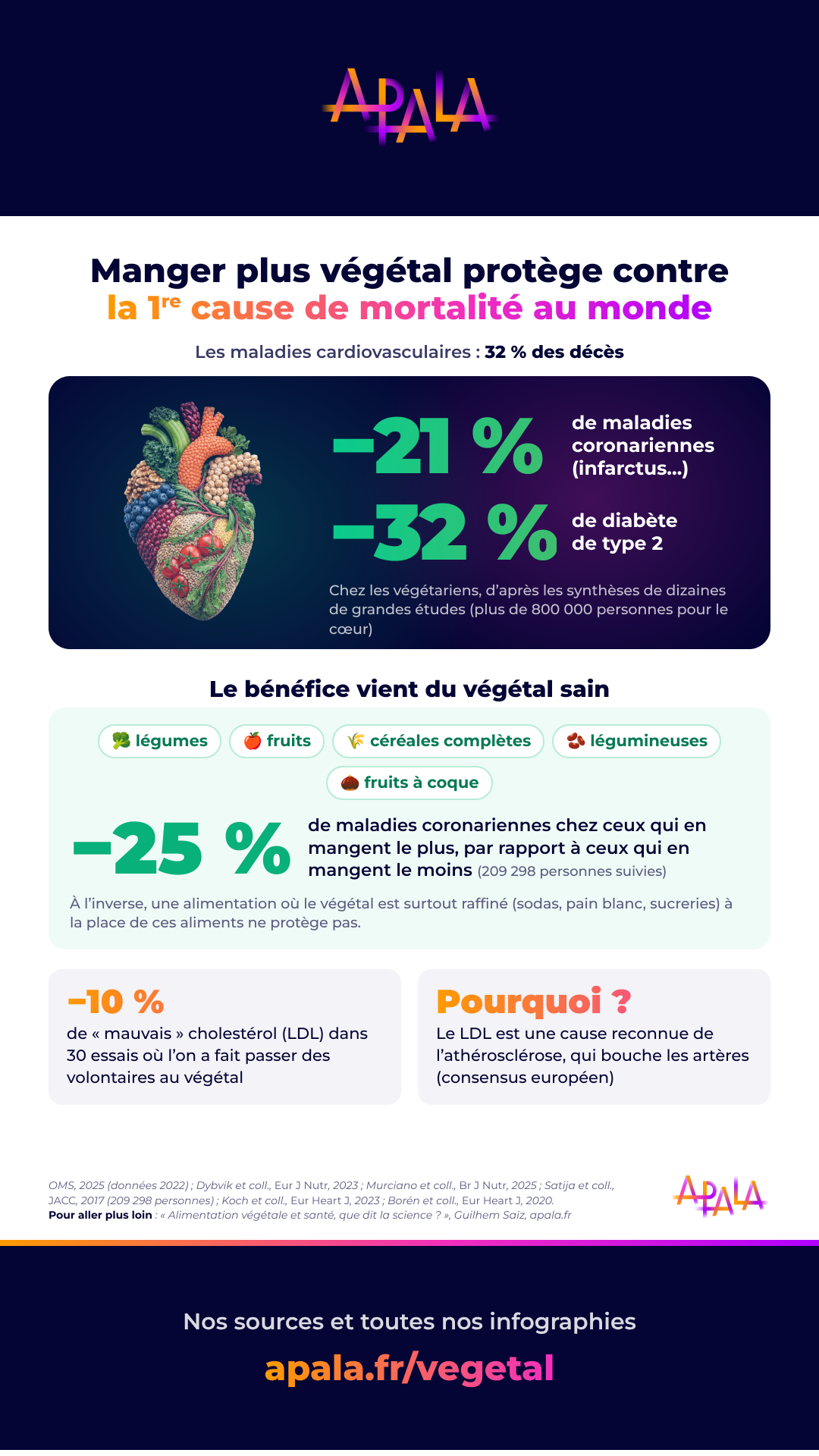
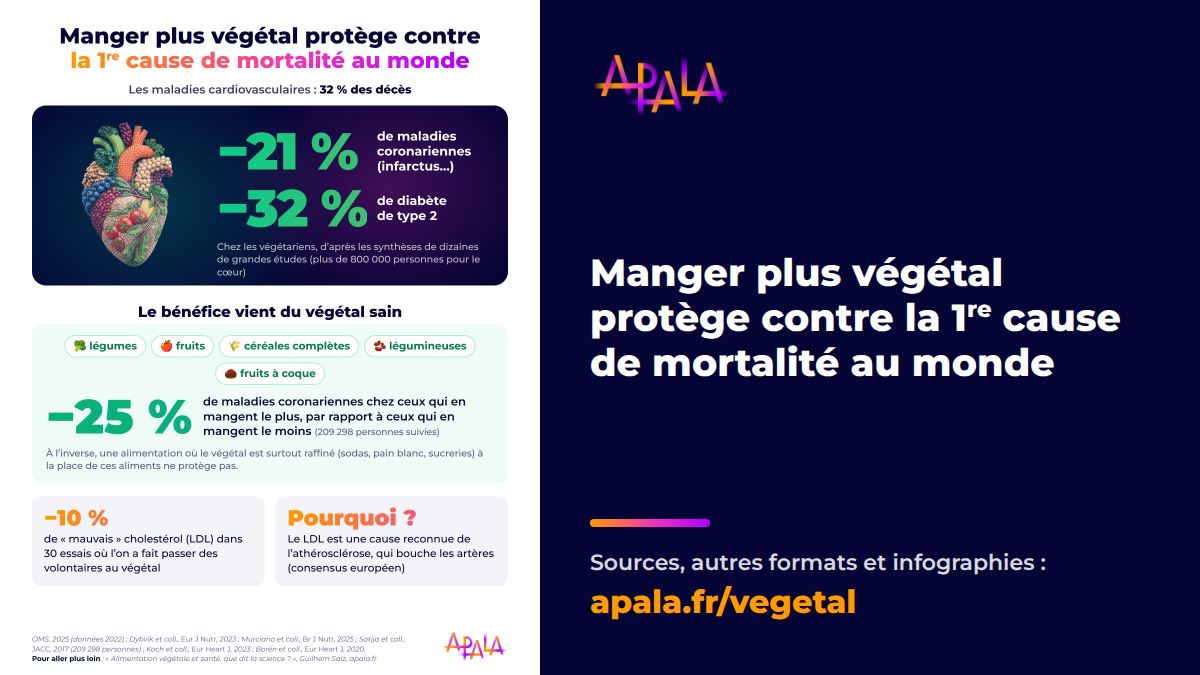
What is missing from our plates
The leading dietary health risk is not what we eat too much of, but what is missing: wholegrains, fruit, nuts, vegetables.
We are missing 10 g of fibre a day
Where to find the fibre we are missing: pulses, nuts, wholegrains.
Our other infographics, updated
Land, water, biodiversity, meat consumption, public opinion: around thirty infographics are being checked against the most recent data.
Formats: 4:5 post (1080 × 1350, Instagram, LinkedIn, Facebook); square (1080 × 1080); story (1080 × 1920); landscape (1920 × 1080, articles, websites, newsletters, X); A4 PDF for printing.
APALA can support you
A think & do tank for the transitions, APALA puts scientific research at the service of decision-makers and the general public.
Talks and presentations
For elected officials, local government departments and residents: why and how to shift diets towards plant-based foods, with the most robust data.
Training
For teams, students and professionals: food, climate, scientific method.
Scientific support
Review of an action plan, figures for a PAT, reasoned answers to questions from elected officials and residents.
Is this work useful to you?
APALA is a public-interest association: our research, our infographics and this page are free and will remain so. To keep them going, every donation counts. €10 from you is nearly €30 for us, after tax relief.
Going further
References
- Agreste, ‘La consommation de viande en France en 2025’, Synthèses n° 451, July 2026. agreste.agriculture.gouv.fr/
- Anses, opinion on the frequency of vegetarian meals in school catering, 2021. www.anses.fr/
- Government, Bilan statistique 2025 de l’application des objectifs d’approvisionnement de la restauration collective (achats 2024), report to Parliament, pp. 63–65. ma-cantine.agriculture.gouv.fr/static/documents/rapport-bilan-statistique-EGALIM_2025.pdf
- I4CE (Rogissart L.), ‘Réduction de la consommation de viande : des politiques publiques bien loin des objectifs de durabilité’, February 2023, figure 1. www.i4ce.org/wp-content/uploads/2023/02/Reduction-de-la-consommation-de-viande-des-politiques-publiques-bien-loin-des-objectifs-de-durabilite.pdf
- Maire-info, ‘Restauration collective, PAT, consommation de viande : les ambitions en demi-teinte de la nouvelle SNANC’, 12/02/2026. www.maire-info.com/restauration-collective/restauration-collective-pat-consommation-de-viande-les-ambitions-en-demi-teinte-de-la-nouvelle-snanc-article-30475
- Anses, INCA 3 study, 2017 (fibre intake: 20 g per day among adults); opinion on the PNNS benchmarks, 2016 (30 g recommended). www.anses.fr/fr/system/files/NUT2014SA0234Ra.pdf
- Scarborough P. et al., ‘Vegans, vegetarians, fish-eaters and meat-eaters in the UK show discrepant environmental impacts’, Nature Food, 2023. doi.org/10.1038/s43016-023-00795-w
- Poore J. and Nemecek T., ‘Reducing food’s environmental impacts through producers and consumers’, Science, 2018. doi.org/10.1126/science.aaq0216
- FAO, FAOSTAT, via Our World in Data, ‘Land use’ (2024 data). ourworldindata.org/land-use
- ADEME, Impact CO2, food (Agribalyse 3.2). impactco2.fr/outils/alimentation
- Réseau Action Climat and Toluna Harris Interactive, Baromètre sur la consommation de viande, wave 3, 2025. reseauactionclimat.org/wp-content/uploads/2025/03/rapport-toluna-harris-barometre-sur-la-consommation-de-viande-2025-vague-3-reseau-action-climat.pdf
- World Resources Institute (Better Buying Lab), ‘Playbook for Guiding Diners Toward Plant-Rich Dishes in Food Service’, 2020, and 2024 guide (90 techniques). www.wri.org/research/playbook-guiding-diners-toward-plant-rich-dishes-food-service
- APALA, ‘Faire choisir le végétal en restauration’, interactive page, 2026. apala.fr/vegetal-restauration/
- Santé publique France, dietary recommendations (PNNS benchmarks), 2019. www.mangerbouger.fr/
- Sokk V., Food impacts, a tool ranking animal products by animal suffering and climate impact (method and sources), based on data by Dominik Peters; code under MIT licence. foodimpacts.org/methods
- Welfare Footprint Institute, methods and studies for measuring the suffering of farmed animals (duration and intensity of pain). welfarefootprint.org/
- Data for Good, ‘Empreinte souffrance des produits d’origine animale’, season 13 project (2025), with Anima, based on the Welfare Footprint. dataforgood.fr/projets/l-empreinte-souffrance-des-produits-d-origine-animale
- Fischer B., ‘Rethink Priorities’ Welfare Range Estimates’, Rethink Priorities, 2023. rethinkpriorities.org/publications/welfare-range-estimates