
This article was also published on the Mr Mondialisation website here: Origine animale des pandémies : il est urgent de changer de modèle
We hope to emerge from the pandemic we are enduring. This emerging coronavirus, one among many (there are thought to be more than 5,000 [1] [2]), is the 3rd in less than 20 years to cause a serious epidemic of international scale. SARS, MERS and COVID-19 are 3 viruses of animal origin, originating in warm-blooded flying vertebrates (bats and birds [3]). Yet the scientists of the Global Virome project [4], which aims to protect us from pandemic risks, tell us that wildlife currently harbours 1.7 million as yet unknown viruses, 50% of which could be capable of infecting humans [5]. The latest report, ‘Échapper à l’ère des pandémies’ [6], from the Intergovernmental Science-Policy Platform on Biodiversity and Ecosystem Services (IPBES) specifies that more frequent, deadlier and costlier pandemics are to be expected, and that the economic impact of the current pandemic is 100 times greater than the estimated cost of preventing them. Consequently, if we do not change our relationship with other animals, we will not avoid future epidemics [7], with all the consequences we now know only too well.
An inconvenient origin
Although the information that the virus probably came from an animal was relayed from the very start of the pandemic, the lessons for preventing future epidemics have not yet been learned. Peter Daszak [8], a zoology researcher and co-author of the aforementioned report, calls for a radical change in the global approach to combating infectious diseases: prevention must be given greater room than reaction [9].
For its part, the Agence nationale de sécurité sanitaire de l’alimentation, de l’environnement et du travail (ANSES) tells us that it has been carrying out research for many years on the mechanisms of cross-species transmission of coronaviruses [10]. These infections are well known to veterinary medicine because they are frequent and can have a significant economic impact, particularly in farms rearing young ruminants, pigs, chickens and turkeys. Vaccination operations are even carried out regularly on commercial farms exposed to the risk of infection. The 3 emerging viruses mentioned above most likely crossed the species barrier through a mammal, and the World Health Organization (WHO) [11] reminds us that several known coronaviruses that have not yet infected humans are circulating in certain animals.
All the authorities reach the same conclusions. To curb the spread of the epidemic, transmission chains must be broken, by preventing transmission to animal populations as early as possible. To counter the emergence of dangerous mutations, the frequency of infections (human and animal) must be reduced [12]. Recommendations shared internationally point in the same direction: close contact between individuals must be avoided. This new practice, which we call ‘social distancing’, makes it possible to halt the spread of the virus and therefore the pandemic. But the cost of this practice is proving very high. At the social and economic level as well as the psychological one, the impact of repeated lockdowns could be the greatest global shock since the Second World War.
Much to the chagrin of mainstream ecologists [13] who maintain an artistic vagueness [14] and of ecology specialists on the subject [15] who receive little media decoding [16], it is indeed from the relationship humans have with the animals they covet that the majority of pandemics originate. Deforestation [17], urbanisation [18], metropolisation [19], industrialisation [20], aviation [21], climate disruption [22], air pollution [23], the disappearance of the wild world [24], the loss of biodiversity [25], its degradation [26], its upheavals [27] and its ‘maltreatment’ [28], the destruction of nature [29], the modification of the environment [30], ecological impact [31], its crisis [32] and even its supposed denial [15], are more or less aggravating factors that stem from human activity, but that are not the very origin of epidemics. It is indeed the infectious transmission from certain animals to humans, a ‘zoonosis’, that is the cause. Clearly naming the factors involved while maintaining vagueness about the cause reveals a strange double standard in the treatment of information, which undeniably hinders understanding of the emergence of zoonoses. It is utterly astonishing that anyone can claim to draw lessons and put forward grand, intricate theories while calling for profound radicalism, all the while carefully avoiding the very origin of what has caused the disastrous situation we are living through.
A non-anthropocentric approach makes it possible to include other animals in our sphere of consideration, respecting their interests and therefore their physical integrity. It protects us against the practices identified as particularly high-risk: hunting, livestock farming and animal exploitation in general. Unfortunately, our food system remains largely based on animal exploitation; our culture is not animalist, and high-risk traditions that are nevertheless rejected by the majority [33] persist.
The action with the greatest potential for reducing epidemic risk
Any zoonotic infection necessarily goes through two stages [34] that are common to every disease emergence: human contact with the infectious agent and its transmission. Zoonotic pathogens are the most likely source of emerging and re-emerging infectious diseases, so much so that one study [35] reveals that new pathogens are twice as likely to be zoonotic in origin as non-zoonotic (58% of human pathogens are). Conversely, according to another study dating from 2001 [36], 39% of human pathogens have infected domestic animals, 44% wild animals and 26% all three categories. Overall, 60% of known infectious diseases [37] and 75% of emerging infectious diseases [38] are of animal origin. They affect 2.5 billion people and kill 2.7 million humans every year. This serious threat to humanity makes it one of the most important subjects of research today [39]. To grasp the scale of it, the Spanish flu, of avian origin [40], alone killed more humans than the tragically more famous First World War. Five centuries earlier, smallpox and influenza (originating in domestic animals) had decimated a large part of the Amerindian population.
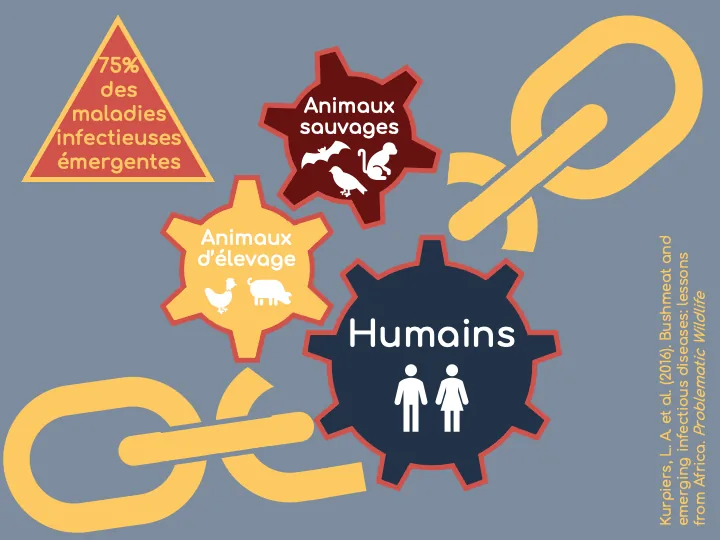
The exploitation of animals, in whatever form, facilitates the close contact between wild animals and humans that lies at the very origin of most zoonoses [41], so much so that, among threatened wild species, those whose populations have declined because of exploitation and habitat loss have shared more viruses with humans [42]. Animalists analyse zoonoses for what they are, not for what they would like them to be. Since they no longer regard animals as resources, they have no blind spot about the uses of animals that the behaviours encouraged by our society perpetuate. By respecting the integrity of animals for their own sake, we avoid most of the risky behaviours responsible for human infections. As it happens, there is today a philosophical and moral current of thought that places consideration for animals for their own sake at its foundation: antispeciesism [43]. By teaching us that species is not a relevant criterion of moral consideration in itself, it advocates an end to all animal exploitation, whatever its form. Since all the zoonotic-risk activities recognised by scientists stem exclusively from speciesist behaviours, the root remedy turns out to be antispeciesism.
A study published last August [44] corroborates these analyses and clearly identifies meat production as the leading cause of epidemics, either directly through increased contact with wild and farmed animals, or indirectly through its environmental impact (the main associated aggravating factor [35] being land-use change, with 27% of land devoted to livestock farming against 1% for urbanisation and its infrastructure [45], for example). These analyses support the work of Serge Morand, an ecologist and research director at the CNRS, which shows that domesticated mammals are the main players in the zoonotic transmission network and that the longer the time since domestication, the more pathogens we share. These researchers state that limiting epidemic risk cannot really be achieved by improving farming practices, and that only a reduction in meat consumption will limit this risk. To that end, they put forward concrete proposals such as, notably, the introduction of a zoonotic tax [44], which could be coupled with a carbon tax, as well as the promotion of plant-based diets through official nutritional recommendations and large-scale information and advice policies. In the immediate term, robust observational and experimental studies [46] show that doubling the proportion of vegetarian meals offered in cafeterias increases sales of vegetarian products from 41% to 79%.
Beyond antispeciesism, there are of course strategies for reducing epidemic risk. Vaccines and medicines make it possible to cope with the crisis. However, these strategies are curative and have limitations. The fact that coronaviruses have moderate to high mutation rates [47] means that vaccines targeting antigens that are not conserved by the infected person are unlikely to remain effective over time. This 2018 study [48] points out that broad-spectrum medicines may have the drawback of potential side effects. Doing what antispeciesism proposes, for its part, seems a good way of drastically reducing the risk preventively.
The general interest of antispeciesism
The devastating impact of the COVID-19 pandemic therefore urges us to stop consuming animal products. A new study [49] even draws an analogy between eating meat and not getting vaccinated. Indeed, getting vaccinated and not eating meat would meet the same three moral imperatives: preventing individual harm, avoiding complicity in collective harm and demonstrating fairness. If we collectively give up eating meat then, just as vaccination coverage provides herd immunity, we drastically reduce the risk of infectious diseases in the public interest. As with vaccination, this duty is pro tanto, that is, it applies only to a certain extent. If there is no alternative to meat and refusing it endangers human life, it no longer applies. In that case, eating meat to survive imposes a necessary risk on others. However, those who have rich and varied food options, as we can now enjoy in the West, clearly have an interest, according to a certain precautionary principle, in collectively avoiding all meat, wherever it comes from. Although the epidemics that have infected humans so far have not wiped out humanity, science has documented cases where diseases have caused the extinction of an entire species [50].
If we do not want to live through another epidemic that would force us into further social distancing, on top of the many burdensome everyday inconveniences, we must collectively avoid the riskiest behaviours, namely livestock farming and hunting in particular, and animal exploitation in general. However, these behaviours have been rooted in human cultures since time immemorial. What we are calling for, then, is a major evolution of the human species [51]. Far from the caricatures projected onto its political project by its detractors, antispeciesism proves to be far more pragmatic than it appears. By minimising epidemic risks as far as possible, it offers a transformative preventive potential, chosen at lower cost, rather than crisis management that is endured, dramatic and exorbitant. Beyond these aspects, it fits perfectly within the continuing expansion of our sphere of consideration for the improvement of everyone’s conditions, and soon, animals’ too.
References
[1] Wikipédia (s. d.). ‘Coronavirus’. fr.wikipedia.org/wiki/Coronavirus#cite_note-10.1128/JVI.06540-11-5
[2] Glaunsinger, B. (2020). Coronaviruses 101: Focus on Molecular Virology [video, at 2 min 50 s]. Innovative Genomics Institute – IGI. YouTube. youtu.be/8_bOhZd6ieM?t=170
[3] Woo, P. C. Y., Lau, S. K. P., Lam, C. S. F. et al. (2012). ‘Discovery of Seven Novel Mammalian and Avian Coronaviruses in the Genus Deltacoronavirus Supports Bat Coronaviruses as the Gene Source of Alphacoronavirus and Betacoronavirus and Avian Coronaviruses as the Gene Source of Gammacoronavirus and Deltacoronavirus’. Journal of Virology, 86(7), 3995-4008. doi.org/10.1128/JVI.06540-11
[4] Global Virome Project (n.d.). Global Virome Project [project website]. web.archive.org/web/20250124130200/https://www.globalviromeproject.org/
[5] Carroll, D., Daszak, P., Wolfe, N. D. et al. (2018). ‘The Global Virome Project’. Science, 359(6378), 872-874. doi.org/10.1126/science.aap7463
[6] Intergovernmental Science-Policy Platform on Biodiversity and Ecosystem Services (IPBES) (29 October 2020). Échapper à l’« ère des pandémies » : Les experts mettent en garde contre de pires crises à venir ; Options proposées pour réduire les risques [press release]. ipbes.net/sites/default/files/2020-11/20201029 Media Release IPBES Pandemics Workshop Report FR_Final.pdf
[7] Detrier, A. (20 October 2020). ‘SADS-CoV : un nouveau coronavirus transmis par les porcs aux humains pourrait causer une pandémie’. Maxisciences. web.archive.org/web/20210517202647/https://www.maxisciences.com/sante/sads-cov-un-nouveau-coronavirus-transmis-par-les-porcs-aux-humains-pourrait-causer-une-pandemie_art44939.html
[8] Global Virome Project (n.d.). ‘Peter Daszak’. Global Virome Project. web.archive.org/web/20240506235509/https://www.globalviromeproject.org/who-we-are/leadership/peter-daszak
[9] Thiberge, C. (29 October 2020). ‘Prévenir les pandémies plutôt que les guérir serait cent fois moins coûteux’. Le Monde. lemonde.fr/planete/article/2020/10/29/prevenir-les-pandemies-plutot-que-guerir-serait-cent-fois-moins-couteux_6057801_3244.html
[10] French Agency for Food, Environmental and Occupational Health & Safety (Anses) (2 March 2020). ‘Les coronavirus. Carte d’identité et rôle de l’Anses’. web.archive.org/web/20201226004644/https://www.anses.fr/fr/content/les-coronavirus
[11] World Health Organization (WHO) (n.d.). ‘Coronavirus’. who.int/fr/health-topics/coronavirus/coronavirus#tab=tab_1
[12] World Health Organization (WHO) (31 December 2020). ‘SARS-CoV-2 Variants’. Disease Outbreak News. who.int/emergencies/disease-outbreak-news/item/2020-DON305
[13] Gesbert, O. (25 January 2021). ‘Bruno Latour : “Ce virus est là pour nous préparer à l’épreuve suivante, le nouveau régime climatique”’ [radio programme]. La Grande Table idées, France Culture. web.archive.org/web/20210125144311/https://www.franceculture.fr/emissions/la-grande-table-idees/redevenir-terrestres-avec-bruno-latour
[14] de Boissieu, D. (25 March 2020). ‘Coronavirus : le jour où les animaux se révoltèrent contre les humains…’. Reporterre. reporterre.net/Coronavirus-le-jour-ou-les-animaux-se-revolterent-contre-les-humains
[15] Collective of ecologists (8 April 2020). ‘La prochaine pandémie est prévisible, rompons avec le déni de la crise écologique’. Libération. liberation.fr/debats/2020/04/08/la-prochaine-pandemie-est-previsible-rompons-avec-le-deni-de-la-crise-ecologique_1784471/
[16] Lévêque, C. (8 April 2020). ‘La destruction de la biodiversité a-t-elle engendré le Coronavirus ?’. European Scientist. europeanscientist.com/fr/environnement/la-destruction-de-la-biodiversite-a-t-elle-engendre-le-coronavirus/
[17] Reporterre (7 May 2020). ‘Les recherches sur les liens entre déforestation et épidémies sont insuffisantes, alertent des scientifiques’. Reporterre. reporterre.net/Les-recherches-sur-les-liens-entre-deforestation-et-epidemies-sont-insuffisantes-alertent
[18] Faburel, G. (2 April 2020). ‘Pandémie : “L’urbanisation et la métropolisation généralisées sont le creuset de la crise sanitaire”’. Marianne. marianne.net/agora/humeurs/pandemie-l-urbanisation-et-la-metropolisation-generalisees-sont-le-creuset-de-la
[19] Astier, M. (28 March 2020). ‘“La métropolisation du monde est une cause de la pandémie”’ [interview with G. Faburel]. Reporterre. reporterre.net/La-metropolisation-du-monde-est-une-cause-de-la-pandemie
[20] Shah, S. (March 2020). ‘Contre les pandémies, l’écologie’. Le Monde diplomatique. monde-diplomatique.fr/2020/03/SHAH/61547
[21] Reporterre (18 March 2020). ‘L’aviation a joué un rôle central dans la propagation du coronavirus’. Reporterre. reporterre.net/L-aviation-a-joue-un-role-central-dans-la-propagation-du-coronavirus
[22] Guitton-Boussion, J. (31 January 2020). ‘Le coronavirus, une épidémie favorisée par l’avion et le dérèglement climatique’. Reporterre. reporterre.net/Le-coronavirus-une-epidemie-favorisee-par-l-avion-et-le-dereglement-climatique
[23] Roux, G. (23 March 2020). ‘Le rôle de la déforestation et de la pollution dans l’épidémie de Covid-19’. franceinfo. franceinfo.fr/sante/maladie/coronavirus/le-role-de-la-deforestation-et-de-la-pollution-dans-l-epidemie-de-covid-19_3872685.html
[24] Duquesne, J. (17 March 2020). ‘Coronavirus : “La disparition du monde sauvage facilite les épidémies”’ [interview with S. Morand]. Marianne. marianne.net/societe/coronavirus-la-disparition-du-monde-sauvage-facilite-les-epidemies
[25] Radisson, L. (29 October 2020). ‘Érosion de la biodiversité et pandémies : le pire est à venir’. Actu-Environnement. actu-environnement.com/ae/news/biodiversite-pandemies-rapport-ipbes-36397.php4
[26] Mouterde, P. (4 April 2020). ‘Coronavirus : la dégradation de la biodiversité en question’. Le Monde. lemonde.fr/sciences/article/2020/04/04/coronavirus-la-degradation-de-la-biodiversite-en-question_6035591_1650684.html
[27] Valo, M. (4 April 2020). ‘Coronavirus : “L’origine de l’épidémie de Covid-19 est liée aux bouleversements que nous imposons à la biodiversité”’ [interview with P. Grandcolas]. Le Monde. lemonde.fr/sciences/article/2020/04/04/pandemies-nous-offrons-a-des-agents-infectieux-de-nouvelles-chaines-de-transmission_6035590_1650684.html
[28] Pouliquen, F. (3 April 2020). ‘Coronavirus : “Cette épidémie est la conséquence d’une biodiversité que l’on maltraite”, selon Philippe Grandcolas’. 20 Minutes. 20minutes.fr/planete/2752743-20200403-coronavirus-epidemie-consequence-biodiversite-maltraite-selon-philippe-grandcolas
[29] Vidal, J. (18 March 2020). ‘“Tip of the iceberg”: is our destruction of nature responsible for Covid-19?’. The Guardian. theguardian.com/environment/2020/mar/18/tip-of-the-iceberg-is-our-destruction-of-nature-responsible-for-covid-19-aoe
[30] Vidard, M. (18 March 2020). ‘Coronavirus : En quoi la pandémie actuelle est-elle liée à l’environnement ?’ [interview with J.-F. Guégan]. Le virus au carré, France Inter. radiofrance.fr/franceinter/podcasts/le-virus-au-carre/coronavirus-en-quoi-la-pandemie-actuelle-est-elle-liee-a-l-environnement-8129780
[31] Billard, S. (17 March 2020). ‘“Le Covid-19 était inévitable, et même prévisible” du fait de notre impact écologique’ [interview with R. Gozlan]. L’Obs. nouvelobs.com/planete/20200317.OBS26163/le-covid-19-etait-inevitable-et-meme-previsible-du-fait-de-notre-impact-ecologique.html
[32] Guibert, C. (19 March 2020). ‘Laurence Tubiana : “Le coronavirus est lié à la crise écologique, à nos modes de vie”’ [interview]. Ouest-France. ouest-france.fr/sante/virus/coronavirus/entretien-laurence-tubiana-le-coronavirus-est-lie-l-ecologie-nos-modes-de-vie-6786251
[33] Ifop (2020). Référendum sur la protection animale : Les Français soutiennent les animaux [survey for Caniprof]. caniprof.com/wp-content/uploads/2020/07/Enquête-Ifop-x-Caniprof-Les-Français-soutiennent-les-animaux.pdf
[34] Childs, J. E., Richt, J. A. and Mackenzie, J. S. (2007). ‘Introduction: Conceptualizing and Partitioning the Emergence Process of Zoonotic Viruses from Wildlife to Humans’. In J. E. Childs, J. S. Mackenzie and J. A. Richt (eds), Wildlife and Emerging Zoonotic Diseases: The Biology, Circumstances and Consequences of Cross-Species Transmission (pp. 1–31). Springer. doi.org/10.1007/978-3-540-70962-6_1
[35] Woolhouse, M. E. J. and Gowtage-Sequeria, S. (2005). ‘Host Range and Emerging and Reemerging Pathogens’. Emerging Infectious Diseases, 11(12), 1842–1847. doi.org/10.3201/eid1112.050997
[36] Cleaveland, S., Laurenson, M. K. and Taylor, L. H. (2001). ‘Diseases of humans and their domestic mammals: pathogen characteristics, host range and the risk of emergence’. Philosophical Transactions of the Royal Society of London. Series B: Biological Sciences, 356(1411), 991–999. doi.org/10.1098/rstb.2001.0889
[37] Salyer, S. J., Silver, R., Simone, K. and Barton Behravesh, C. (2017). ‘Prioritizing Zoonoses for Global Health Capacity Building—Themes from One Health Zoonotic Disease Workshops in 7 Countries, 2014–2016’. Emerging Infectious Diseases, 23(13), S55–S64. doi.org/10.3201/eid2313.170418
[38] Kurpiers, L. A., Schulte-Herbrüggen, B., Ejotre, I. and Reeder, D. M. (2016). ‘Bushmeat and Emerging Infectious Diseases: Lessons from Africa’. In F. M. Angelici (ed.), Problematic Wildlife (pp. 507–551). Springer. doi.org/10.1007/978-3-319-22246-2_24
[39] World Health Organization (WHO) (2009). Pandemic influenza preparedness and response: a WHO guidance document. iris.who.int/handle/10665/44123
[40] Hoag, H. (16 February 2014). ‘Study revives bird origin for 1918 flu pandemic’. Nature. doi.org/10.1038/nature.2014.14723
[41] Jones, B. A., Grace, D., Kock, R. et al. (2013). ‘Zoonosis emergence linked to agricultural intensification and environmental change’. Proceedings of the National Academy of Sciences, 110(21), 8399–8404. doi.org/10.1073/pnas.1208059110
[42] Johnson, C. K., Hitchens, P. L., Pandit, P. S. et al. (2020). ‘Global shifts in mammalian population trends reveal key predictors of virus spillover risk’. Proceedings of the Royal Society B: Biological Sciences, 287(1924), 20192736. doi.org/10.1098/rspb.2019.2736
[43] Lepeltier, T., Bonnardel, Y. and Sigler, P. (3 December 2018). ‘L’antispécisme est un projet politique réaliste’. L’Amorce. lamorce.co/lantispecisme-est-un-projet-politique-realiste/
[44] Espinosa, R., Tago, D. and Treich, N. (2020). ‘Infectious Diseases and Meat Production’. Environmental and Resource Economics, 76(4), 1019–1044. doi.org/10.1007/s10640-020-00484-3
[45] Ritchie, H. and Roser, M. (2019). ‘Land Use’. Our World in Data. ourworldindata.org/land-use
[46] Garnett, E. E., Balmford, A., Sandbrook, C., Pilling, M. A. and Marteau, T. M. (2019). ‘Impact of increasing vegetarian availability on meal selection and sales in cafeterias’. Proceedings of the National Academy of Sciences, 116(42), 20923–20929. doi.org/10.1073/pnas.1907207116
[47] van Dorp, L., Acman, M., Richard, D. et al. (2020). ‘Emergence of genomic diversity and recurrent mutations in SARS-CoV-2’. Infection, Genetics and Evolution, 83, 104351. doi.org/10.1016/j.meegid.2020.104351
[48] Totura, A. L. and Bavari, S. (2019). ‘Broad-spectrum coronavirus antiviral drug discovery’. Expert Opinion on Drug Discovery, 14(4), 397–412. doi.org/10.1080/17460441.2019.1581171
[49] Jones, B. (2021). ‘Eating meat and not vaccinating: In defense of the analogy’. Bioethics, 35(2), 135–142. doi.org/10.1111/bioe.12834
[50] Dodds, W. (2019). ‘Disease Now and Potential Future Pandemics’. In W. Dodds, The World’s Worst Problems (pp. 31–44). Springer. doi.org/10.1007/978-3-030-30410-2_4
[51] Olivier, D. (18 March 2019). ‘David Olivier : “L’animalisme nous mène à un progrès civilisationnel majeur”’. Le Monde. lemonde.fr/idees/article/2019/03/18/david-olivier-oui-l-animalisme-nous-mene-a-un-progres-civilisationnel-majeur_5437818_3232.html





0 comments