
This article was written for the tenth issue of the revue Virage de l'AVF, on the subject of vegan agriculture. You can find it published here: L'élevage : un maximum d'impact pour un minimum d'apports.
The media space is so dominated by defenders of small-scale livestock farming that one could almost believe we are born in cowpats and that without cows, humanity is heading for ruin. More seriously, the background refrain playing at high volume is that livestock farming creates something magical that we could not do without, as if farm animals on pastures were the source of some fertile, nourishing alchemy. In fact, this is not the case: animals depend on plants, not the other way round, and this is a basic notion of ecology, taught by the concept of the trophic level. We will therefore see here that moving away from livestock farming allows us to avoid an incredible leakage of resources.
Animals do not make nitrogen or organic matter, they consume it
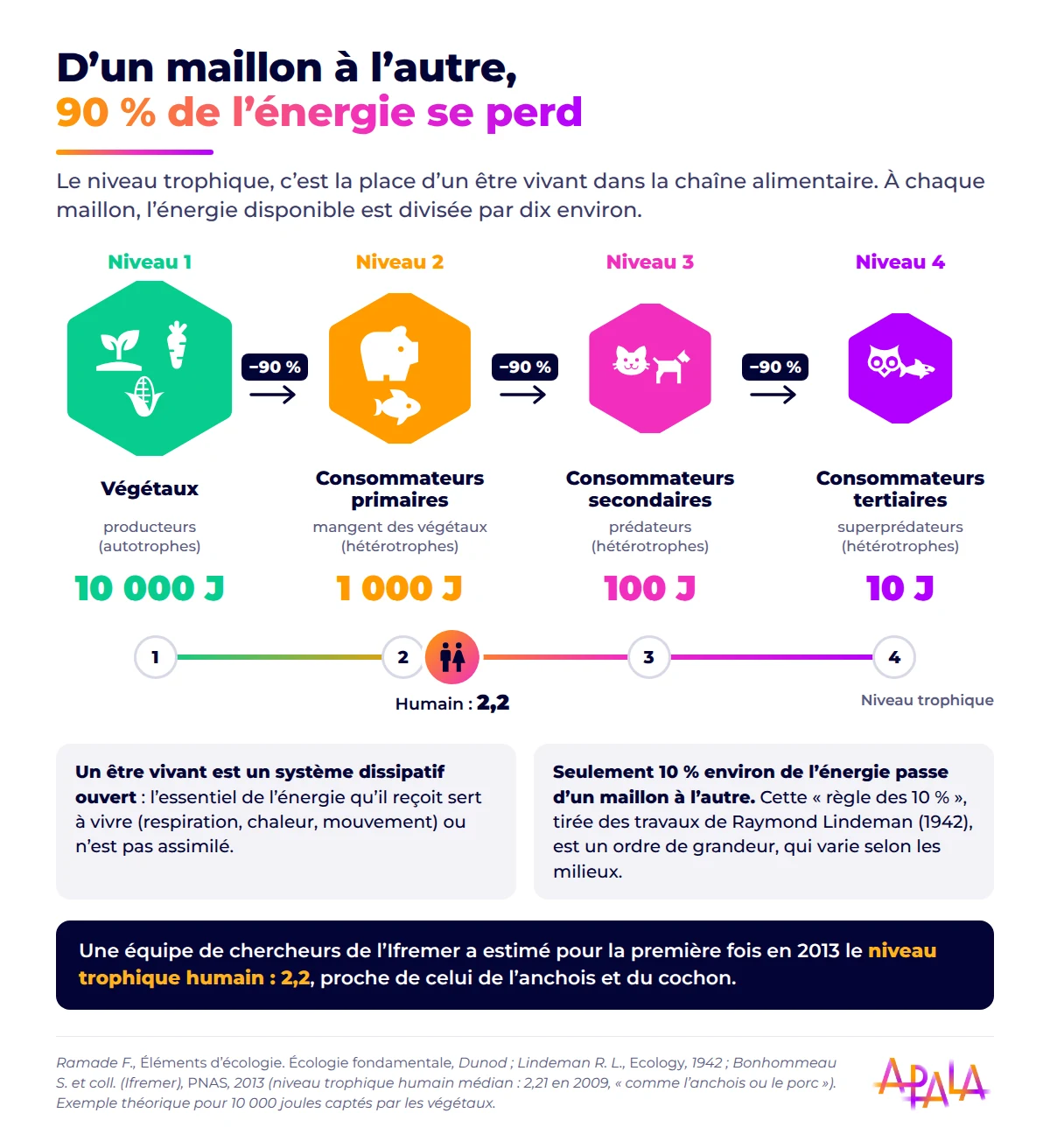
The trophic web is what is commonly known as the food chain. Each level represents a link in that chain. This web is limited to 5 levels. At the bottom, at the first level, are the producers, the autotrophs, which are able to create organic matter from inorganic matter. From level 2 onwards we move on to the heterotrophs, the animals, of which we are part. We depend on the organic matter created by plants, since we are unable to create any from sunlight, minerals and water. Plants convert carbon dioxide into organic molecules: carbohydrates, lipids and proteins. Animals merely transform these molecules, at the cost of a significant loss. They do not produce nitrogen, and when it passes through animals, the nitrogen cycle becomes a leak: there are losses in the form of milk, meat and animal carcasses. Contrary to popular belief, manure is not, so to speak, a free lunch. Globally, through crops grown for animal feed, livestock farming consumes 55 Mt (million tonnes) of synthetic nitrogen and returns only 26 Mt in organic form [1]. That represents 29 Mt that go straight into marine and terrestrial environments, which contributes both to global warming and to the eutrophication of these environments, thereby fostering dead zones. Moreover, if we want to reduce nitrogen fertilisers, one primary source of nitrogen has to be replaced by another primary source, not by a recycled flow such as manure. Only symbiotic fixation can do this, and it is not livestock farming that is capable of it, but the cultivation of legumes. According to the Solagro team, if we do the calculation, we find that if we want to scale up organic farming, animal manure can supply only part of the nitrogen inputs [2].
Animals at level 2 are primary consumers, and those above them (level 3) are called secondary consumers. Raymond Lindeman, an American ecologist, established for the first time in 1942 a law of energy transfer in ecosystems. It measures the ecological efficiency of a consumer (the ratio of a consumer’s net production to the net biomass production it has consumed). His finding is that only a fraction of energy is passed from one trophic level to the one above. Known by his name, it is also called the 10% law because, on average, 90% of energy is lost at each additional level [3].
The disastrous yield of livestock farming

From this, the inefficiency of livestock farming becomes clearer. Yet the researcher Anne Mottet, a former agricultural economist at the Institut de l’Élevage who is now in charge of livestock policies at the FAO (Food and Agriculture Organization of the United Nations), considers it dangerous that investment is now turning towards alternatives [4]. In 2017, she attempted to rehabilitate livestock farming by publishing a study asking whether livestock are on our plates or at our table. In the end, her results are unequivocal. To produce 1 kg of boneless meat, on average 2.8 kg of human-edible feed are needed for ruminant meat and 3.2 kg for monogastric meat. The conversion ratio for producing animal protein is supposed to favour livestock farming, given the high protein content of animal products. Yet here too, this ratio shows that livestock farming clearly consumes resources rather than contributing them. The gross ratio takes into account all animal feed, whereas the net ratio considers only animal feed that humans can eat, which therefore competes directly with human food. Her results show that to produce one animal protein, on average 10 plant proteins are needed, meaning that 9 proteins out of 10 are lost, a 90% loss. The ratio falls to 2.6 if we consider only those that can be eaten directly (a 62% loss). Returning to a gross ratio of 10, this confirms the famous 10% law discussed above. It is only at local scale, in marginal and therefore unrepresentative cases, that livestock farming can contribute to food security. This is a dead end, since more than 99% of this contributing livestock farming is accounted for by ruminants, which are responsible for 80% of the sector’s greenhouse gas emissions [5]. It is a clear impasse in the face of climate change.
The lost food opportunity

While food waste amounts to a third of global production, a study published in 2018 in the scientific journal PNAS [6] drives the point home by showing that food losses due to animal products exceed all so-called conventional losses (leaks in supply chains or product spoilage, food loss). The researchers show that plant-based replacement products can produce, per unit of cultivated area, 20 times and 2 times more nutritionally similar food than beef and eggs respectively, the most and least resource-intensive categories of animals. They specify that producing one gram of animal-derived protein (or calorie) requires roughly an order of magnitude more resources and emissions than producing one gram of plant-derived protein. Consuming resource-intensive food products instead of more efficient and equally nutritious alternatives can therefore be regarded as an effective food loss. They call this the food opportunity cost. Unlike conventional food loss, the loss caused by resource-intensive products is hidden food that can be recovered through changes in diets. In this respect, food preferences play a key role in determining and mitigating food losses. As a reminder, in France [7] as around the world, livestock farming consumes ⅓ of the cereals produced each year, and even though Anne Mottet’s study shows that 86% of global consumption of animal feed is not edible by humans, livestock farming would provide only 25% of global protein intake. Poore and Nemecek, the authors of the largest meta-analysis [8] of our food system known to date, concluded that livestock farming provided 18% of calories and 37% of total protein, while, combining pasture and the crops grown for its feed, it would occupy 77% of the world’s agricultural land [9].
Update of 3 November 2026: with more recent FAO data, Our World in Data now estimates that livestock farming occupies 80% of the world’s agricultural land (pasture and crops intended for animals) and provides 17% of calories and 38% of protein in the global diet, farmed fish included (Our World in Data) [10].
The land freed up
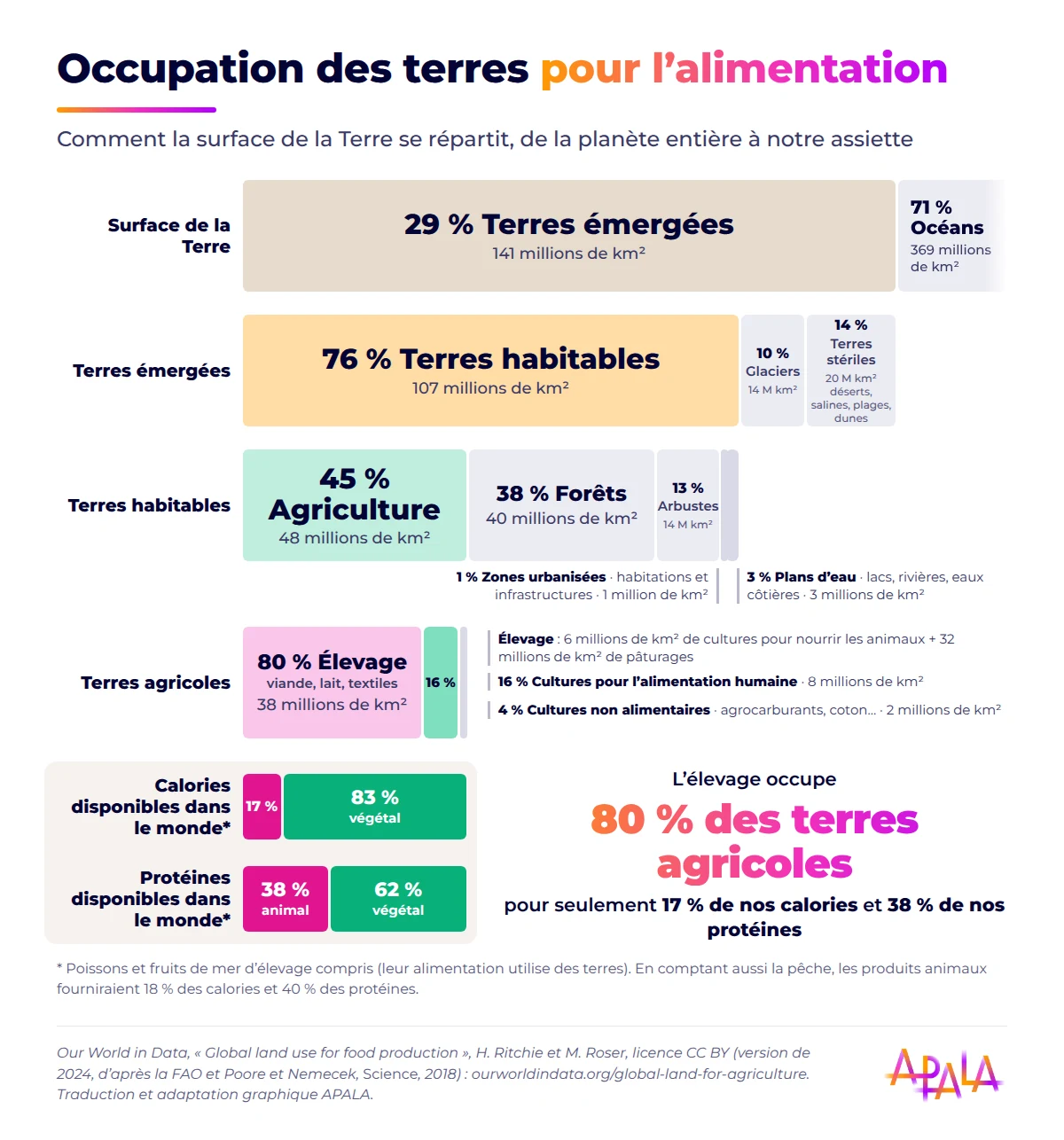
While it is true that livestock farming has shaped our landscapes since its beginnings around 10,000 years ago, it is nonetheless hard to grasp. Occupying 27% of ice-free land compared with 1% for built-up areas (cities and infrastructure), it covers more than forests, barren land (deserts, salt flats and rock) and glaciers (26%, 19% and 10% respectively). It occupies 40% of so-called arable land. Around half of this is grassland, 35% of which could be converted directly into crops. This represents 1.3 billion hectares, which could not, a priori, be put to better use than grazing ruminants. This is considerable, since it is also roughly 27% of the world’s agricultural land, or 10% of ice-free land. So what should we do with all these grasslands freed from livestock farming? Could we rethink landscapes so that they are not anthropocentric, that is, dedicated solely to the benefit of humans? And what if, ultimately, taking animals’ interests into account became a key principle in organising the landscape?
First, we can give priority to reforestation for carbon sequestration, which is urgent in the face of climate change. Next, to preserve open landscapes or grasslands that provide us with welcome ecosystem services, we can set up sanctuaries looked after by rescued farm animals or by wild animals. School and university visits would add further interest to their preservation. Finally, some cropland will still be needed for our food, but substantial diversification will be required in order to move away from the giant monocultures intended for livestock. Redirecting CAP subsidies away from livestock farmers would help fund these large-scale changes as well as the conversions. There is already the ‘green payment’, or greening, which is a direct payment to farmers intended to reward specific actions for the environment. It is a decoupled payment (that is, independent of the type of production), amounting to around €80/ha, or €2 billion per year. Perhaps we could draw inspiration from it to imagine the sustainable diet of tomorrow, which must already be put into practice today.
References
[1] Uwizeye, A., de Boer, I. J. M., Opio, C. I. et al. (2020). ‘Nitrogen emissions along global livestock supply chains’. Nature Food, 1(7), 437-446. doi.org/10.1038/s43016-020-0113-y
[2] Solagro (2021). ATELIER 1 - ÉLEVAGE - Comment réfléchir aux évolutions de l’élevage et à sa place dans les systèmes de production ? [video]. Vimeo. vimeo.com/503407885/ccf984cdd6
[3] Ramade, F. (2009). Éléments d’écologie. Écologie fondamentale (4th ed.), chap. 5, ‘Flux de l’énergie et cycle de la matière dans les écosystèmes’. Dunod, p. 442. books.google.fr/books?id=kk7knrTlNekC&pg=PA442
[4] Marchand, N. (7 May 2021). ‘Anne Mottet, femme de Thomas Pesquet, défend le plancher des vaches’. Réussir. reussir.fr/articles/anne-mottet-femme-de-thomas-pesquet-d…
[5] Garnett, T., Godde, C., Muller, A. et al. (2017). Grazed and confused? Ruminating on cattle, grazing systems, methane, nitrous oxide, the soil carbon sequestration question – and what it all means for greenhouse gas emissions. Food Climate Research Network (FCRN), University of Oxford, p. 118. oxfordmartin.ox.ac.uk/downloads/reports/fcrn_gnc_report.pdf
[6] Shepon, A., Eshel, G., Noor, E. and Milo, R. (2018). ‘The opportunity cost of animal based diets exceeds all food losses’. Proceedings of the National Academy of Sciences, 115(15), 3804-3809. doi.org/10.1073/pnas.1713820115
[7] Passion Céréales (31 October 2017). ‘Le marché des céréales françaises’. Passion Céréales. web.archive.org/web/20211024000112/https://www.passioncer…
[8] Poore, J. and Nemecek, T. (2018). ‘Reducing food’s environmental impacts through producers and consumers’. Science, 360(6392), 987-992. doi.org/10.1126/science.aaq0216
[9] Ritchie, H. and Roser, M. (2019). ‘Land Use’. Our World in Data. ourworldindata.org/land-use
[10] Ritchie, H. and Roser, M. (2024). ‘Half of the world’s habitable land is used for agriculture’. Our World in Data. ourworldindata.org/global-land-for-agriculture

0 comments