by Thomas Lepeltier, Usbek & Rica, 28 April 2025
Scenarios in which an artificial intelligence would wipe out humanity rest on baseless probabilities and on motivations that are never explained. Caution is useful, the article argues, but suspending the development of AI would be a mistake.
In brief
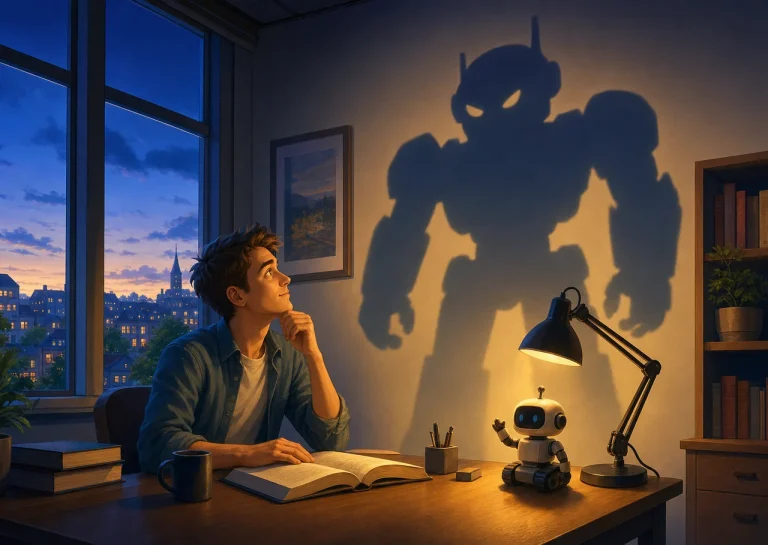
- The fear of machines turning against their creators is longstanding, from The Iliad to Terminator; it has taken hold among AI specialists themselves since the 2000s.
- The author challenges the authority of these predictions: being an expert in a technology does not make one a better forecaster, and the risk percentages put forward measure only an impression.
- He acknowledges that AI will not always be harmless, but considers a pause pointless and unrealistic: risks are dealt with by observing them, and other countries would carry on.
The article’s three arguments
Figures that measure nothing
Announcing a ‘one in a hundred’ chance of extinction within a few decades lends a scientific veneer, but neither catastrophic scenarios nor possible futures can be counted. These estimates remain arbitrary.
Why would a super-AI want to destroy us?
The analogy with animal exploitation does not hold: humans exploit animals because they benefit from it, and do not seek to exterminate them. A superior intelligence would rather have an interest in coexisting.
Machines that remain correctable
The scenario of the AI that turns the Earth into a paperclip factory assumes either a badly written instruction, which would be corrected, or a will that it does not have. And AIs can be used to monitor or deactivate other AIs.
‘The fact that humans will retain control over AIs does not mean that they will always be harmless.’Thomas Lepeltier, Usbek & Rica, 28 April 2025
Why this debate interests us
Artificial intelligence is one of APALA’s working themes, and it sees it as a tool of intellectual emancipation and an accelerator of transitions. This article usefully shifts the debate: rather than asking whether AI will exterminate us, we should ask what concrete risks it poses and how we learn to manage them, as we did for the motor car.
Questions for debate
- Can any credit be given to an extinction probability put forward by an expert, and under what conditions?
- Should a technology be regulated before it is understood, or after seeing it in operation?
- Which AI risks deserve more attention than the extinction scenario?
To go further on apala.fr
Summary written by Claude (Opus 5.5 model), an artificial intelligence, for APALA, based on the article published in Usbek & Rica on 28 April 2025. The views expressed are those of the author. An error? Write to us.


0 comments