
This article is a response to the arguments in defence of livestock farming formulated specifically in Frédéric Denhez’s article published in Le Figaro in April 2021, but also in Bob Holmes’s article published in Knowable magazine in August 2022 and then translated in Slate, in the video from the YouTube channel What I've Learned, which has a large audience, and finally in the latest ARTE Regards programme, which offers yet another plea for animal welfare as a means of perpetuating livestock farming. It is based on the leading scientific studies in the field and offers a contextualised analysis that fits fully within the continuity of the evolution of our food system.

To Frédéric Denhez’s question, ‘Will a meat-free diet (really) save the planet?’, we answer without hesitation: no, because the planet does not need saving. More than a mere rhetorical device, with or without us, it will continue on its long galactic journey without, a priori, feeling any need to be saved. Logically, our diet cannot save it. But then, whom can it save, if not the animals whose interests Frédéric Denhez, once again, renders invisible?
Livestock GHG emissions: the elephant in the room
By retracing part of the history of our food, Frédéric Denhez deserves credit for looking at phenomena that go under the radar. In claiming that eating meat is a climate crime and an ecocide worse than nuclear power, he is mistaken in his choice of terms. Our moral system does not confuse moral patients with those that are not. Since nature is not a moral patient, one cannot concretely disrespect it. The moral patient [6] is the one whose treatment by a moral agent can be subject to moral evaluation and characterised as good or bad. One can try to preserve a certain functioning of nature for its inhabitants, but without speaking of a crime against it, as it does not fall within our moral system. Only an individual can be the victim of a crime. On the other hand, Frédéric Denhez is not wrong to say that, from a climate point of view, livestock farming is worse than nuclear power, which is recognised as a low-carbon energy source [7]. He comes close to reality in putting the emissions of livestock farming at a fifth of global anthropogenic emissions. But, estimating that livestock farming is responsible for three quarters of the emissions of our food system [8] and including the carbon sequestration potential of reforesting the freed-up land, it seems reasonable to count on more than a quarter [9], or even 28% according to the largest meta-analysis of global food systems to date [10] and 31% when considering the instantaneous global warming potential of methane [11]. While it is clear that a reduction in all greenhouse gases is needed, by agreeing on the share attributable to livestock farming, we will have taken a big step towards identifying the problem that this sector represents on its own from a climate perspective.

A shared concern about space
Frédéric Denhez’s main argument reflects a concern among defenders of livestock farming: that eliminating it would close off our landscapes. First, note that by raising this argument against animal rights advocates, he concedes the point to them. Although it is understandable, this argument is obviously not of the same order as that of animal rights advocates, who consider it immoral to kill someone who does not want to die. Here, the difference is clear between the idea we have of a landscape, which falls outside our moral system, and the deliberate, unnecessary killing of an individual, which strikes directly at our ethics, based on empathetic perceptions that diminish with evolutionary divergence time [12]. In moral philosophy, this is the distinction between instrumental value and intrinsic value. Opposing a reconversion of the livestock farming sector on health grounds no longer makes sense today, since it is scientifically established that everyone can live without animal products [13] and that vegetarian and vegan diets are in fact protective of our health [14]. It is rather a matter of conservative projections, in the sense that the fear of a change to the landscape is what dominates.
While it is true that livestock farming has shaped our landscapes for 10,000 years, this is nonetheless hard to appreciate. One anthropologically striking fact seems worth revealing in order to grasp what is at stake in this question. The last African Humid Period, which began 15,000 years ago and ended 5,000 years ago, was characterised by biomes rich in vegetation, forests and scrub, with little desert. The Neolithic Subpluvial, or ‘last pluvial period of the Sahara’, was a period of humid, rainy climate that affected North Africa and the Arabian Peninsula during the last 5,000 years of that period. Although the desertification that followed is mainly a natural phenomenon (driven by the Earth’s orbit), in his study [15], the anthropologist David K. Wright argues that livestock farming is an active agent of the desertification of the Sahara, which spreads as humans guide cattle towards new pastures. Coupled with population growth, pastoralism promotes devegetation and regime shifts in ecosystems: a reduction in net primary productivity, a homogenisation of flora, the transformation of the landscape into a biozone dominated by shrubs, and a general increase in xerophytic vegetation (plants that live only in arid environments). He considers the introduction of cattle to be the decisive factor behind local events in which ecological thresholds were crossed. It is cattle, he argues, that would have catalysed the negative feedbacks between terrestrial and atmospheric domains.

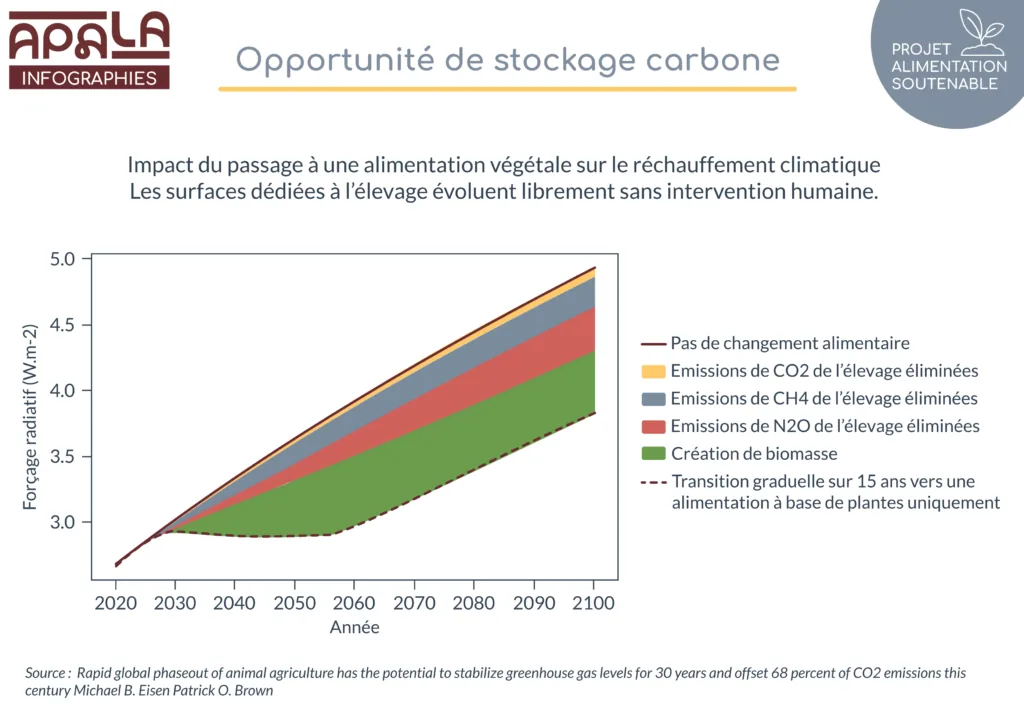
Today, livestock farming occupies 27% of the planet’s land surface [16], compared with 1% for built-up areas (cities and infrastructure). That is more than forests, barren land (deserts, salt flats and rock) and glaciers (26%, 19% and 10% respectively). Nearly three quarters of agricultural land is used as pasture and for fodder crops, with the remaining quarter made up of arable crops. If we combine pasture and cropland used for animal feed, around 80% of all agricultural land [17] is used for the production of meat and dairy products, which swallows up 41% of the world’s cereal production [17] and 76% of its soya [18], to provide only 18% of humanity’s calorie intake and 37% of its protein [19]. If the world’s population consumed fewer animal products, we would eat more plants directly from crops, thereby increasing the proportion of cropland used for human food. But the area used for animal feed would fall. In the hypothetical scenario in which the whole world adopted a vegan diet, researchers estimate that total agricultural land use would fall from 4.1 billion hectares to 1 billion hectares. This 75% reduction in land footprint is equivalent to the combined area of North America and Brazil. Note that most of this reduction would come from eliminating beef, mutton and milk, which would free up the land used for pasture, but also from ending the massive crops that feed all farmed animals. And that is not all: as vegetation recovers, freeing up the land makes it possible to sequester the carbon stored in regrowing forests and grasslands. Different diets thus have an associated carbon opportunity cost. Given that global greenhouse gas emissions amounted to 55.3 Gt CO2 equivalent in 2018 [20], of which around 18 Gt CO2 equivalent came from the food system (2015), this new study published in PLOS Climate [21] shows that phasing out livestock farming, even in the absence of any other emissions reductions, would lead to lasting falls in atmospheric levels of methane and nitrous oxide and slow the accumulation of carbon dioxide. By the end of the century, these would have the same cumulative effect on the atmosphere’s warming potential as a reduction of 25 gigatonnes per year in anthropogenic CO2 equivalent emissions, which is half of the net emissions reductions needed to limit warming to 2°C. This scenario would stabilise greenhouse gas levels for 30 years and offset 68% of CO2 equivalent emissions over this century. Fortunately, there is no trade-off between production emissions and opportunity costs: what reduces emissions the most also brings the greatest carbon sequestration potential. Shifting to a more plant-based diet achieves both objectives, and it is by becoming vegan that the reduction in carbon emissions is greatest.
So how can we keep landscapes open? What should we do with all these grasslands if we want to phase out livestock farming? Could we rethink landscapes so that they are not anthropocentric, that is, dedicated solely to the benefit of humans? And what if taking into account the interests of the animals that live there became a key principle in organising the landscape? To imagine it, one really has to want to think it through. This is the exercise Alix Gancille undertook in her final-year dissertation in landscape architecture [22]. She shows that, at the scale of the Thiérache region (Belgium), plant-based agriculture is in fact able to preserve open landscapes and rich biodiversity. For their part, in ‘Zoopolis. Une théorie politique des droits des animaux’, the philosophers Sue Donaldson and Will Kymlicka reflected [23] on the question: should domesticated animals be allowed to reproduce, and should we aim to build a shared community with them?
Environmentalism’s false good idea about ruminants
In an article published last August [24], George Monbiot, the well-known environmental columnist of The Guardian, argues that organic, pasture-fed beef and lamb products are the worst foods for the environment. Drawing on the landmark report on the subject, ‘Grazed and confused’ [25], produced by the Food Climate Research Network at the University of Oxford, he points out that cropland, part of which is devoted to animal feed, occupies 12% of the Earth’s land surface, while pasture alone occupies 26%. Despite this vast area, pasture-fed livestock produce only 1% of the world’s protein, that is, 1g of protein per person per day.
A ‘carbon sink’ that is ultimately a net emitter
Let us now put the much-vaunted ecosystem services into context. There are many reasons to manage grasslands better in various parts of the world, for example to improve the livelihoods of marginalised communities or to support certain environmental objectives. As for the term ‘carbon sink’, it is a misuse of language that favours the defenders of livestock farming. In reality, the landmark report cited above is unequivocal: its unavoidable conclusion shows that, while livestock grazing has a place in a sustainable food system, that place is limited. The emissions generated by grazing systems always outweigh the removals. Even if management were optimal, emissions would remain positive. Moreover, soils reach carbon equilibrium after a few decades. Any sequestration resulting from good grazing management is therefore limited in time.
According to the Institut national de recherche pour l'agriculture, l'alimentation et l'environnement (INRAE), 86% of the potential for reducing agriculture’s carbon footprint will come from arable crops [26], since grasslands are able to store only around 20% of the emissions of the ruminants grazing on them.
Furthermore, a study published in 2012 [27] compared the environmental impact of conventional, natural and grass-fed beef production systems. The conventional system required 56.3% of the animals, 24.8% of the water, 55.3% of the land and 71.4% of the fossil energy needed to produce 1.0 × 10⁸ kg of beef, compared with the grass-fed system. As well as being more efficient, the conventional system had a carbon footprint equal to 59% of that of the grass-fed system, which was the worst of the three. In other words, the grass-fed system consumes the most resources and emits the most greenhouse gases. Meanwhile, a research article published in the journal Nature in 2014 [28], based on a meta-analysis of 52 life cycle assessment [29] (LCA) studies of animal and plant protein sources, tells us that protein from extensively farmed beef has a carbon footprint 2.1 times greater than that from intensively farmed beef. By comparison, plant-based meat would have a carbon footprint 48 times lower than the latter. It concludes that reducing the number of ruminants worldwide could make a substantial contribution to climate change mitigation goals and generate significant social and environmental co-benefits. More recently, a study [30] estimated the environmental impacts of the diets of 29,210 participants in the NutriNet-Santé study, across four dietary patterns: omnivore, pesco-vegetarian, vegetarian and vegan. Omnivores show by far the highest levels of greenhouse gas emissions, cumulative energy demand and land use, while vegan diets show the lowest. Ruminant meat consumption is the largest contributor.
Overall, with a third of global anthropogenic methane emissions and 80% of livestock farming’s greenhouse gas emissions9, meat and dairy products from ruminants have the highest greenhouse gas emission intensity of all food products. Finally, focusing solely on carbon sequestration can undermine the goals of preserving biodiversity.
The illusion of biodiversity
‘We could not do without livestock farming, and more specifically ruminant farming, without seeing biodiversity plummet.’ This is the assertion that this 2020 meta-analysis, based on 109 independent studies [31], responds to directly. It addresses the potential multitrophic effects on biodiversity by testing the response of animals and plants to livestock grazing as compared with its exclusion. The results refute this persistent belief. For all animals, excluding livestock increased abundance and diversity, with these effects being stronger for trophic levels directly dependent on plants, such as herbivores and pollinators. Detritivores (bacteria, fungi, worms…) were the only trophic level whose abundance fell when livestock were excluded. The researchers also found that the number of years since livestock exclusion influences the animal community, and that its effects are strongest in temperate climates. They highlight the potentially unavoidable cost of livestock grazing for global biodiversity, which must be weighed against its socio-economic benefits.
The bluff of soil fertility
It is worth remembering that animals do not produce nitrogen or organic matter. Only autotrophs (essentially plants) are able to produce organic matter. They convert carbon dioxide into organic molecules: carbohydrates, lipids and proteins. Animals, which are heterotrophs, merely transform these molecules at the cost of a significant loss. At its Afterre 2050 university in February 2021, the Solagro team questioned the place of livestock farming in a workshop devoted to its evolution [32]. It then published the report ‘La place de l’élevage face aux enjeux actuels’ [33], with the aim of informing the debate by recalling contextual elements that are constantly forgotten and by addressing preconceived ideas similar to those propagated by Frédéric Denhez. The team made clear that the report does not represent Solagro’s position, but that it aims to provide foundations that are as factual, objective and well-sourced as possible to shed light on several points of controversy. It points out that the nitrogen cycle is a leaky one: there are losses in the form of milk, meat and exported animal carcasses, as well as losses into watercourses. Contrary to popular belief, manure is not a ‘free lunch’. Moreover, if the aim is to reduce nitrogen fertilisers, one primary source of nitrogen must be replaced by another primary source, and not by a recycling flow such as carcasses and the residues of ingested feed in the form of manure. Only symbiotic fixation can do this, and it is not livestock farming that is capable of it, but the cultivation of legumes. Furthermore, synthetic fertilisers are indeed a primary source of nitrogenous matter, and unsurprisingly the livestock sector is the main source of nitrogen emissions in the agricultural system.
A study published in Nature Food in 2020 [34] takes stock of nitrogen emissions from the livestock sector. Worldwide, through crops grown for animal feed, livestock farming consumes 55 Mt (million tonnes) of synthetic nitrogen, yet returns only 26 Mt in organic form for human agriculture. A further 29 Mt therefore goes directly into marine and terrestrial environments, which contributes both to global warming and to the eutrophication of these environments, thereby fostering dead zones.
Let us return to the main point: the denial of those who eat animal products. Although we know that animals are conscious [35], the defenders of livestock farming do not bother to explain how to come to terms with this simple fact while continuing to eat them. There is a scientific consensus on the capacity of animals to be affected [36], that is, to experience positive or negative emotions. When it is proposed that they be included in our sphere of consideration, defenders of the status quo counter with second-order arguments that stem from considerations external to ethics. We supposedly need to keep eating animals in order to preserve open landscapes such as meadows, heathland, causses, wetlands or bocage. Accordingly, following the intuitive consensus in ethics and moral philosophy, more than 500 philosophers declare animal exploitation unjust and morally indefensible [37]. Let us add a point here that Frédéric Denhez does not seem to have grasped. By defending the consumption of extensively farmed ruminant meat rather than, for example, intensively farmed chickens, he is siding with animal rights advocates, who wish to reduce the number of animals killed. From an ecological point of view this is a misguided idea, but from an animal rights perspective, if meat from intensive farming of smaller animals is replaced, then the number of individuals killed is reduced, and with it the suffering caused. The larger the animal, the more meat can be cut from it. For an equivalent quantity of meat, there are therefore fewer victims.
Redirecting subsidies
The process known as the straw man is well known in the scientific community, because its biases must be avoided in order to obtain usable results. Here, unfortunately, we have to make do with the straw man of brush cutters and of workers who supposedly could not be paid, offered as proof that it is impossible to move away from livestock farming. We supposedly would not have the means to ‘cut the old-fashioned way’ the shrubs that would otherwise cover the meadows. Saying so is not enough; it would also need to be demonstrated. We apparently have the means to pay people to raise and kill more than 1.2 billion animals in France, with externalities so unsustainable that they have not yet been quantified. Yet we would not have the means to pay people to maintain our landscapes by fostering positive externalities?
For example, on the initiative of the Fédération Nationale des Chasseurs (FNC), the hunting law of 24 July 2019 created a biodiversity fund within the new Office Français de la Biodiversité (OFB). This fund is topped up by an eco-contribution from hunters and the State in order to finance projects run by hunting federations for the ‘protection of biodiversity’. Under this eco-contribution scheme [38], when a hunting licence is validated, each hunter contributes €5 to the fund, with a top-up from the State of €10, in order to finance concrete actions in favour of biodiversity: planting hedgerows, restoring forest and wetland environments, and maintaining habitats for wildlife. The State thus pays 10 million to the hunting federations. In its opinion of the Scientific Council on the eco-contribution [39], the OFB highlights a reputational risk, as it finds itself associated with projects of very poor, even bad, quality, which can sometimes run counter to its own missions. This analysis led it to warn of the risks the scheme poses: a legal risk for the OFB owing to the financing of projects whose amounts are not justified. Would it not be more reasonable to subsidise associations recognised as being of public interest to maintain our landscapes?
The latest reforms of the Common Agricultural Policy (CAP) aimed to gradually reduce the importance of instruments that act directly on agricultural prices in favour of direct income support measures unrelated to production levels, through the decoupling of aid. The ‘green payment’, or greening, is a direct payment to farmers intended to reward specific actions benefiting the environment. It is a decoupled payment (that is, independent of the type of production) of around €80/ha, which represents €2 billion per year [40].
Farms geared towards ruminant production (beef, sheep meat, dairy) generate lower incomes on average than wine-growing or large-scale crop farms. They receive the highest percentage of direct aid relative to current pre-tax income [41] (RCAI): beef cattle 250%, sheep and goats 165%, mixed cattle 136%. In its 2021 report [42] on agriculture and food, the Institute for Climate Economics (I4CE) analyses the financing of the French food system and its contribution to sustainability challenges. It argues that the overwhelming majority of this aid is allocated according to criteria incompatible with the transition to a sustainable food system (direct aid of €6.6 billion, including green payments of €2 billion). Furthermore, it considered the aid coupled to meat and milk production (€860 million) to be unfavourable, as it is geared towards maintaining animal production when the latter needs to decrease.
Gloubi-boulga for anyone willing to eat it
Regarding the old cow, Frédéric Denhez says in his article that she is not made to grow old since after a while she is a source of suffering that only extensive veterinary care can contain, at great expense, in vain. To completely demystify this view: animals age in the same way as we do, except that they have no autonomy with regard to the care they could claim if they could benefit from an animal social security system. Nor can they express their pain, and they experience it with varying degrees of intensity. As for the claim that treating her is futile, it is clear that Frédéric Denhez views other beings beyond his own species through an anthropocentric, instrumental lens.
Later in his article, he uses the argumentum ad antiquitatem, also known as the appeal to tradition (or here to historicity), by referring to Cro-Magnon man. Drawing on the study by Anne Mottet [43], who has worked for over 16 years on the development of livestock farming [44], and on a linear programming study of the Dutch agricultural system [45] taken up by INRAE in its infographic “Elevage et occupation des terres” [46], he adds to his enterprise of manufacturing doubt. Indeed, having already been called out by the union Sud-Recherche for denouncing his use of the talking points of the livestock industry [47], he does not give the details that are nonetheless necessary for properly understanding the studies and the interpretation of the results that can be drawn from them. He claims that if everyone adopted a vegan diet, more land would be needed to feed humanity, because crop by-products could not be used by animals to produce protein (meat, milk, eggs) that humans can eat. Although in theory this may seem true, the wording is misleading. This fictional model is not put in context and does not state the very strong premises that belong to a perfectly improbable scenario. It is based on the assumption that the French would consume the amount of protein recommended by the European Food Safety Authority (EFSA), namely 57 g of protein per day per person, whereas they actually consume 112 g (of which 70 g come from animal products) [48]. It assumes no imports or exports of animal feed and foodstuffs. Finally, he gives the impression that livestock farming is necessary to make use of inedible resources, when it is on the whole inefficient. In reality, it consumes more protein than it returns in the form of food products, and it is the source of a food opportunity cost (lost food) greater than global food waste [49], which is already estimated at a third of total food production. In fact, the small area potentially usable by livestock farming would only need to be considered if the area under crops could not feed us. Yet we make more animals than humans depend on that land for food, even though they intrinsically cause losses because of their higher trophic level. The opposite is therefore true: more people could be fed, from a smaller area, if everyone adopted a vegan diet. According to this same reference study, replacing the animal products in each category with nutritionally equivalent plant products in terms of protein and calories would make it possible to produce 2 to 20 times more food per unit of area on arable land. It concludes that, after nutritional adjustment, a vegan diet could feed 100% more citizens, whereas stopping all food waste, from producer to household, would feed only 30% more. A 2013 study [50] calculated that 36% of the calories produced by the world’s crops are used for animal feed, while only 12% are recovered in the form of animal products. Given the current mix of crop uses, growing food exclusively for direct human consumption could, in principle, feed an additional 4 billion people.
Frédéric Denhez invites us to imagine the landscape behind our plate. He claims that the agri-food system that led to the disaster of intensive, concentration-camp-like farms is regaining its health through veganism. Yet this is precisely the raison d’être of the association L214, which reveals the other side of the story by publishing videos from French slaughterhouses. No one can decently condone these horrors, even though they are the reason everyone is able to eat meat. As well as being false, his assertion misses the point. Although slaughterhouses shock by the rate at which animals are killed and dismembered, what shocks most is the horror the animals endure and the way in which they are killed. But, beyond an implicit romanticisation (to say the least, a strange one), does he think that killing an animal at the bottom of the garden is a solution? On top of the fundamental problem of consent, which he does not even grasp, the act remains the most malevolent there could be. Moreover, since at least pharaonic Egypt, we have never stopped distancing ourselves from the guilt of this ‘food murder’ [51] by resorting to sophisticated rituals or by telling ourselves stories. Without even addressing the questions of generalisation, do we wish to perpetuate this tragedy when it is no longer necessary? An animal reared industrially has no more or less interest in living than one reared in a bucolic setting. Both have precisely the same interests in living, as we do. An abundant scientific and popular literature on antispeciesism makes it possible to understand these elementary notions. The question remains: why try to justify the unjustifiable?
In an interview on “Interdit d’interdire” [52] broadcast to mark the publication of the book “La première histoire globale de l’alimentation”, the author Florent Quellier explains why France is less tolerant than Great Britain of a different way of eating. Our Catholic culture conditions us to communion around the table, whereas England, with its Protestant culture, is attached to individual freedom. This difference can be found in the language itself: ‘gluten-free’ in English and ‘sans gluten’ in French. The emphasis is placed on deprivation by means of the preposition ‘sans’, unlike the meaning of the word ‘free’, which refers to the possibility of being liberated from eating gluten. We are therefore more suspected of eating differently in France, which may even be perceived as an affront. We particularly form a society at the table. There is a sort of normative injunction to eat like everyone else. We have even developed a kind of institution known as French-style diplomacy.
Even though Frédéric Denhez points out that it is only two centuries since an Anglo-American Protestantism began associating meat with flesh, he does not dare to use the term ‘plant-based steak’ and prefers the term ‘ersatz’, which has been widely popularised by defenders of livestock farming. It would be a shame to marginalise vegetarian and vegan products that are healthier and better for the environment over a murky question of vested interests. He claims that the farmer must be clearly identifiable for meat to be properly embodied, and that this is better than a fake ersatz when we do not know where or by whom it is made, if indeed it is made by someone and not directly by the GAFAM. What is the problem with calling a steak plant-based meat when it can prevent the fibre deficiency from which 87% of French adults and 98% of French children suffer [53], a major risk factor for colorectal cancer [54], which is the second leading cause of cancer death in France [55]? Beyond the question of animals, the good health of our fellow citizens in a better-preserved environment should concern us all. If defenders of livestock farming view its cultural and traditional contribution positively, the recognised negative externalities must now be added to the balance: we eat too many animal products to stay in good health [56], the environmental costs are unsustainable, and above all we no longer wish to accept the mistreatment inflicted on animals.
This reasoned and properly sourced response is a concrete example of the principle of the asymmetry of bullshit, known as Brandolini’s law.
Wikipédia, Loi de Brandolini :
It states that ‘the amount of energy needed to refute nonsense is an order of magnitude greater than that needed to produce it’. This principle criticises the propaganda technique (en) of spreading disinformation en masse in order to exploit the credulity of a certain audience by appealing to its fast, instinctive and emotional way of thinking. Put simply: while it is easy to create a piece of false information, in substance and in form, within a few minutes, it will probably take several hours to dismantle each point and thereby demonstrate the falseness of the whole. It follows from this adage that disinformation has a significant advantage over truth, because restoring the truth is particularly costly in time and energy. This principle is one of the reasons why the burden of proof must not be reversed. In science and law, in particular, the burden of proof always lies with the person making the claim; otherwise anyone could assert anything without the slightest evidence.
References
[1] Denhez, F. (15 April 2021). “L’alimentation sans viande va-t-elle (vraiment) sauver la planète ?” [opinion piece]. Le Figaro. lefigaro.fr/vox/societe/l-alimentation-sans-viande-va-t-elle-vraiment-sauver-la-planete-20210415
[2] Holmes, B. (18 August 2022). “How much meat can we eat — sustainably?”. Knowable Magazine. doi:10.1146/knowable-081722-1. knowablemagazine.org/content/article/food-environment/2022/how-much-meat-can-we-eat-sustainably
[3] Holmes, B. (30 September 2022). “Manger un peu de viande peut être plus durable qu’un régime vegan” (trans. B. Viennot). Slate.fr. slate.fr/story/233971/sauver-planete-manger-viande-ecologie-elevage-paturages-emissions-carbone-steak
[4] Everett, J. (What I’ve Learned) (25 April 2021). Eating less Meat won’t save the Planet. Here’s Why [video]. YouTube. youtu.be/sGG-A80Tl5g
[5] ARTE (27 October 2022). Vers de nouveaux modes d’élevage. ARTE Regards [video, now private]. YouTube. youtu.be/IHjS69rOKzg
[6] Jeangène Vilmer, J.-B. (2008). “Présentation”. In Éthique animale. Presses universitaires de France, coll. “Éthique et philosophie morale”, pp. 19-20. cairn.info/ethique-animale--9782130562429-page-19.htm
[7] Ritchie, H. and Rosado, P. (2020). “Nuclear Energy”. Our World in Data. ourworldindata.org/nuclear-energy
[8] Sandström, V., Valin, H., Krisztin, T., Havlík, P., Herrero, M. and Kastner, T. (2018). “The role of trade in the greenhouse gas footprints of EU diets”. Global Food Security, 19, 48-55. doi.org/10.1016/j.gfs.2018.08.007
[9] Crippa, M., Solazzo, E., Guizzardi, D., Monforti-Ferrario, F., Tubiello, F. N. and Leip, A. (2021). “Food systems are responsible for a third of global anthropogenic GHG emissions”. Nature Food, 2(3), 198-209. doi.org/10.1038/s43016-021-00225-9
[10] Science (2019). “Erratum for the Research Article ‘Reducing food’s environmental impacts through producers and consumers’ by J. Poore and T. Nemecek”. Science, 363(6429), eaaw9908. doi.org/10.1126/science.aaw9908
[11] Müller, M. (2021). The contributions of animal agriculture and major fossil-fuel-based industries to global warming [preprint, 11 April 2021]. landwirtschaft.jetzt, p. 22. landwirtschaft.jetzt/wp-content/uploads/2021/04/2021-04-1…
landwirtschaft.jetzt (2021). “The contributions of animal agriculture to climate change”. landwirtschaft.jetzt/en/klimawandel/
[12] Miralles, A., Raymond, M. and Lecointre, G. (2019). “Empathy and compassion toward other species decrease with evolutionary divergence time”. Scientific Reports, 9, 19555. doi.org/10.1038/s41598-019-56006-9
[13] Melina, V., Craig, W. and Levin, S. (2016). “Position of the Academy of Nutrition and Dietetics: Vegetarian Diets”. Journal of the Academy of Nutrition and Dietetics, 116(12), 1970-1980. doi.org/10.1016/j.jand.2016.09.025
[14] Dinu, M., Abbate, R., Gensini, G. F., Casini, A. and Sofi, F. (2017). “Vegetarian, vegan diets and multiple health outcomes: A systematic review with meta-analysis of observational studies”. Critical Reviews in Food Science and Nutrition, 57(17), 3640-3649. doi.org/10.1080/10408398.2016.1138447
[15] Wright, D. K. (2017). “Humans as Agents in the Termination of the African Humid Period”. Frontiers in Earth Science, 5, 4. doi.org/10.3389/feart.2017.00004
[16] Ritchie, H. and Roser, M. (2019). “Land Use”. Our World in Data. ourworldindata.org/land-use
[17] Ritchie, H. (4 March 2021). “If the world adopted a plant-based diet, we would reduce global agricultural land use from 4 to 1 billion hectares”. Our World in Data. ourworldindata.org/land-use-diets
[18] Ritchie, H. and Roser, M. (2021). “Soy”. Our World in Data [page now redirected to “Drivers of Deforestation”]. ourworldindata.org/soy
[19] Poore, J. and Nemecek, T. (2018). ‘Reducing food’s environmental impacts through producers and consumers’. Science, 360(6392), 987-992. doi.org/10.1126/science.aaq0216
[20] Commissariat général au développement durable (2020). Chiffres clés du climat. France, Europe et Monde. Édition 2021, part 2, « Quelles sont les quantités de gaz à effet de serre émises dans le monde ? ». SDES. statistiques.developpement-durable.gouv.fr/edition-numerique/chiffres-cles-du-climat/pdf/pages/partie2/partie2.pdf
[21] Eisen, M. B. and Brown, P. O. (2022). “Rapid global phaseout of animal agriculture has the potential to stabilize greenhouse gas levels for 30 years and offset 68 percent of CO2 emissions this century”. PLOS Climate, 1(2), e0000010. doi.org/10.1371/journal.pclm.0000010
[22] L214 (31 August 2020). « Libérer le paysage de l’exploitation animale. Un cas pratique » [presentation of Alix Gancille’s dissertation]. Blog L214. blog.l214.com/2020/08/31/liberer-paysage-lexploitation-animale-cas-pratique
[23] Giroux, V. (7 March 2019). « À propos des citoyennes nonhumaines dans la zoopolis ». L’Amorce. lamorce.co/a-propos-des-animaux-de-compagnie-dans-la-zoopolis/
[24] Monbiot, G. (16 August 2022). “The most damaging farm products? Organic, pasture-fed beef and lamb”. The Guardian. theguardian.com/environment/2022/aug/16/most-damaging-farm-products-organic-pasture-fed-beef-lamb
[25] Garnett, T., Godde, C., Muller, A. et al. (2017). Grazed and confused? Ruminating on cattle, grazing systems, methane, nitrous oxide, the soil carbon sequestration question – and what it all means for greenhouse gas emissions. Food Climate Research Network (FCRN), University of Oxford. tabledebates.org/publication/grazed-and-confused
[26] Pellerin, S., Bamière, L. and Réchauchère, O. (2019). Stocker du carbone dans les sols français. Quel potentiel au regard de l’objectif 4 pour 1000 et à quel coût ? Synthèse du rapport d’étude. INRA, 114 pp. hal.inrae.fr/hal-02284521
[27] Capper, J. L. (2012). “Is the Grass Always Greener? Comparing the Environmental Impact of Conventional, Natural and Grass-Fed Beef Production Systems”. Animals, 2(2), 127-143. doi.org/10.3390/ani2020127
[28] Ripple, W. J., Smith, P., Haberl, H., Montzka, S. A., McAlpine, C. and Boucher, D. H. (2014). ‘Ruminants, climate change and climate policy’. Nature Climate Change, 4(1), 2-5. doi.org/10.1038/nclimate2081
[29] Nijdam, D., Rood, T. and Westhoek, H. (2012). “The price of protein: Review of land use and carbon footprints from life cycle assessments of animal food products and their substitutes”. Food Policy, 37(6), 760-770. doi.org/10.1016/j.foodpol.2012.08.002
[30] Rabès, A., Seconda, L., Langevin, B. et al. (2020). “Greenhouse gas emissions, energy demand and land use associated with omnivorous, pesco-vegetarian, vegetarian, and vegan diets accounting for farming practices”. Sustainable Production and Consumption, 22, 138-146. doi.org/10.1016/j.spc.2020.02.010
[31] Filazzola, A., Brown, C., Dettlaff, M. A. et al. (2020). “The effects of livestock grazing on biodiversity are multi‐trophic: a meta‐analysis”. Ecology Letters, 23(8), 1298-1309. doi.org/10.1111/ele.13527
[32] Solagro (2021). ATELIER 1 – ÉLEVAGE – Comment réfléchir aux évolutions de l’élevage et à sa place dans les systèmes de production ? [video]. Vimeo. vimeo.com/503407885
[33] Couturier, C., Duru, M., Couturier, A., Deconchat, M. and Malafosse, F. (2021). La place de l’élevage face aux enjeux actuels : éléments de réflexion. Solagro and INRAE. hal.inrae.fr/hal-03687741
[34] Uwizeye, A., de Boer, I. J. M., Opio, C. I. et al. (2020). “Nitrogen emissions along global livestock supply chains”. Nature Food, 1(7), 437-446. doi.org/10.1038/s43016-020-0113-y
[35] Low, P., Panksepp, J., Reiss, D., Edelman, D., Van Swinderen, B. and Koch, C. (2012). The Cambridge Declaration on Consciousness. Francis Crick Memorial Conference, Cambridge (United Kingdom), 7 July 2012. fcmconference.org/img/CambridgeDeclarationOnConsciousness…
[36] Proctor, H. S., Carder, G. and Cornish, A. R. (2013). ‘Searching for Animal Sentience: A Systematic Review of the Scientific Literature’. Animals, 3(3), 882-906. doi.org/10.3390/ani3030882
[37] Collectif (4 October 2022). ‘L’appel de quatre cents philosophes : “Nous déclarons que l’exploitation animale est injuste et moralement indéfendable”’ [opinion piece]. Le Monde. lemonde.fr/idees/article/2022/10/04/l-appel-de-quatre-cents-philosophes-nous-declarons-que-l-exploitation-animale-est-injuste-et-moralement-indefendable_6144379_3232.html
[38] Fédération nationale des chasseurs (n.d.). ‘Écocontribution : comment les chasseurs préservent-ils la biodiversité ?’. chasseurdefrance.com. chasseurdefrance.com/agir/eco-contribution/
[39] Conseil scientifique de l’OFB (18 November 2021). Avis du Conseil scientifique de l’OFB sur l’éco-contribution. Office français de la biodiversité. ofb.gouv.fr/sites/ofb-gouv-fr/files/2026-02/avis5-csofb-ecocontribution.pdf
[40] Ministry of Agriculture and Food (February 2022). La PAC en un coup d’œil. agriculture.gouv.fr/telecharger/111692?token=07e53b9558f48592cc77676d240ea66ca9e27ff3dee87140d921ba93cf2c6309
[41] INRAE (8 May 2021). ‘Comment la PAC soutient-elle le revenu des agriculteurs ?’ [interview with Vincent Chatellier]. inrae.fr/actualites/comment-pac-soutient-elle-revenu-agriculteurs
[42] I4CE (14 October 2021). Décryptage des financements du système alimentaire français et de leur contribution aux enjeux de durabilité. Institute for Climate Economics. i4ce.org/publication/decryptage-financements-systeme-alimentaire-francais-climat/
[43] Mottet, A., de Haan, C., Falcucci, A., Tempio, G., Opio, C. and Gerber, P. (2017). ‘Livestock: On our plates or eating at our table? A new analysis of the feed/food debate’. Global Food Security, 14, 1-8. doi.org/10.1016/j.gfs.2017.01.001
[44] Mottet, A. (n.d.). Personal website [personal page]. Google Sites. sites.google.com/view/annemottet
[45] Van Kernebeek, H. R. J., Oosting, S. J., Van Ittersum, M. K., Bikker, P. and De Boer, I. J. M. (2016). ‘Saving land to feed a growing population: consequences for consumption of crop and livestock products’. The International Journal of Life Cycle Assessment, 21(5), 677-687. doi.org/10.1007/s11367-015-0923-6
[46] INRAE (18 March 2019). ‘[Infographie] Elevage et occupation des terres’. inrae.fr/actualites/infographie-elevage-occupation-terres
[47] SUD-Recherche EPST, branche INRAE (25 February 2020). ‘Quand ajouter un “e” à INRA ne suffit pas’. sud-recherche.org/SPIPprod/spip.php?article3275
[48] Our World in Data (n.d.). ‘Daily protein supply from animal and plant-based foods’ [interactive chart]. ourworldindata.org/grapher/daily-protein-supply-from-animal-and-plant-based-foods
[49] Shepon, A., Eshel, G., Noor, E. and Milo, R. (2018). ‘The opportunity cost of animal based diets exceeds all food losses’. Proceedings of the National Academy of Sciences, 115(15), 3804-3809. doi.org/10.1073/pnas.1713820115
[50] Cassidy, E. S., West, P. C., Gerber, J. S. and Foley, J. A. (2013). ‘Redefining agricultural yields: from tonnes to people nourished per hectare’. Environmental Research Letters, 8(3), 034015. doi.org/10.1088/1748-9326/8/3/034015
[51] Chemin, A. (7 October 2022). ‘Comment nous avons désanimalisé la viande’. Le Monde. lemonde.fr/idees/article/2022/10/07/comment-nous-avons-desanimalise-la-viande_6144786_3232.html
[52] RT France (1st April 2021). Interdit d’interdire / Culture : numéro 199, avec Florent Quellier [video, no longer available]. YouTube. youtu.be/C--tvg4IJ8M
[53] Santé publique France (2018). Étude de santé sur l’environnement, la biosurveillance, l’activité physique et la nutrition (Esteban 2014-2016). Volet Nutrition. Chapitre Consommations alimentaires. santepubliquefrance.fr/determinants-de-sante/nutrition-et-activite-physique/documents/rapport-synthese/etude-de-sante-sur-l-environnement-la-biosurveillance-l-activite-physique-et-la-nutrition-esteban-2014-2016-chapitre-consommations-alimentair
[54] Réseau NACRe (2020, updated in 2024). ‘Surpoids, obésité et risque de cancer, les principales données’. reseaunacre.eu/prevention-primaire/facteurs-nutritionnels/surpoids-obesite-et-cancer
[55] Institut national du cancer (updated 22 July 2026). ‘Les cancers colorectaux’. cancer.fr/professionnels-de-sante/statistiques-et-chiffres-sur-les-cancers/epidemiologie-des-cancers/cancer-colorectal
[56] Springmann, M., Spajic, L., Clark, M. A. et al. (2020). ‘The healthiness and sustainability of national and global food based dietary guidelines: modelling study’. BMJ, 370, m2322. doi.org/10.1136/bmj.m2322


0 comments