
by Antoine Buéno, L’Opinion, 17 June 2024
The world will not run out of oil: the peak oil thesis, which has fuelled collapse narratives for half a century, no longer holds. This is bad news for the climate, but the transition will not be imposed on us by geology: it will depend only on our choices.
In brief
- Starting point: the announcement of a deposit discovered by Russia beneath Antarctica and estimated at 511 billion barrels, equivalent to around 14 years of current global consumption (100 million barrels per day).
- For the author, this news, which is bad for geopolitics, for a continent that is a sanctuary and for the climate, nonetheless invalidates the ‘running dry’ scenario on which collapse theories are founded.
- Conclusion: the question is no longer whether oil will run out, but whether we will be able to deploy in time a decarbonised energy mix capable of replacing it.
The article’s three arguments
Oil is not going to run out
With this deposit and the fields already being exploited, humanity would still have at least thirty years of consumption ahead of it, whereas the International Energy Agency expects demand to plateau before 2030.
The end of the ‘Mad Max’ scenario
Peak oil, formulated by the geologist Hubbert in 1956, has served as the basis for the idea that a civilisation born of fossil fuels would disappear along with them. If oil does not run out, this narrative of collapse through scarcity falls apart.
The transition is a choice, not a constraint
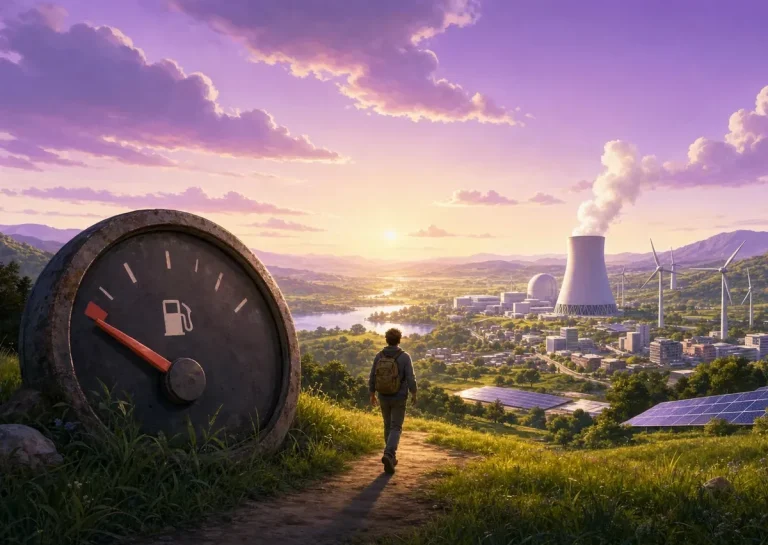
An abundance of oil changes nothing about the climate problem: we already had enough fossil fuels to cause catastrophic warming. But with no shortage to force it, the transition rests entirely on our decisions.
‘Since peak oil will not happen, our responsibility is total.’Antoine Buéno, L’Opinion, 17 June 2024
Why this debate interests us
APALA champions an ecology that looks at the facts rather than at end-of-the-world narratives. This article usefully shifts the debate: if the constraint does not come from resources, it must come from our collective choices, and that is one more reason to act. A word of caution: the size of the Antarctic deposit is an estimate, and mining there is prohibited under international treaties.
Questions for debate
- Do collapse narratives help us to act, or do they distract from the real constraints of the transition?
- With no shortage to force it, what can accelerate the phase-out of fossil fuels?
- For which uses will we still need oil in a low-carbon world?
To go further on apala.fr
Summary written by Claude (Opus 5.5 model), an artificial intelligence, for APALA, based on the article published in L’Opinion on 17 June 2024. The views expressed are those of the author. Spotted a mistake? Write to us.



0 comments